
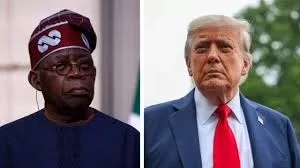
The federal government said late Monday that diplomatic channels with Washington were working effectively to calm tensions following US President Donald Trump’s threats of military action over the alleged persecution of Christians.
Minister of Information and National Orientation Mohammed Idris told Sky News’ The World with Yalda Hakim, “Channels of communication with the United States have been opened” and that discussions were helping US officials better understand Nigeria’s “diversity and complexity,” he said.
“We are talking to them, and they are beginning to see the situation more clearly,” Idris said. “Much of the information circulating is based on data that cannot withstand proper scrutiny.”
“We believe that most of the information is a result of a lack of a proper understanding of the diversity and complexity of the problem we have at hand,” he said.
The minister alleged that certain lobby groups in the US are linked to a proscribed separatist organisation in Nigeria and are working to misinform American authorities.
“Let me also put it out there that we are seeing a direct connection between (US) lobbyists and (a) proscribed terrorist organisation in Nigeria, and we have seen how they have set up this lobby in the US, contacting high-up people in the United States to help them to lobby,” he said.
He also claimed that some of the US concerns were fuelled by lobbying linked to separatist groups, particularly the Indigenous People of Biafra (IPOB), which Nigeria classifies as a terrorist organisation.
“There is a direct connection between some US lobbyists and this proscribed group,” Idris said.
The comments follow weeks of escalating rhetoric between Abuja and Washington. On 4 November, presidential adviser Bayo Onanuga accused US Senator Ted Cruz of sponsoring misinformation after Cruz co-sponsored a resolution urging investigations into the killing of Christians.
The presidency claimed the senator had ties to IPOB representatives, who have stepped up lobbying in Washington this year.
IPOB, led by detained activist Nnamdi Kanu, welcomed Trump’s designation and called for an international inquiry into alleged state abuses. Since February, its envoys have met US lawmakers including Representatives Craig Goldman and Gus Bilirakis to highlight what they describe as the systematic marginalisation of the Igbo ethnic group.
Despite the row, Idris struck a conciliatory tone, calling for renewed cooperation on counter-terrorism.
“The United States has helped Nigeria fight terrorism in the past. We want that partnership to continue,” he said.
Idris noted that Nigeria still values its long-standing security partnership with Washington and called for continued collaboration in combating terrorism.
“What we are saying is that, yes, indeed, the situation is there, we have conflict in Nigeria, we have a security situation in Nigeria, but in the past the United States government has helped Nigerian authorities to deal with this situation; so we are calling on them to partner with us once again, to help push this, and then we have peace once and for all in our country,” he said.
The minister expressed surprise at some figures and positions from the US government regarding Nigeria’s internal challenges, urging a better understanding of the country’s realities.
READ ALSO: US Military Preparing Air Strike Options for Nigeria After Trump Order – Report
“We want to tell the world that this is not the case, and to appeal to them, (that) we share the concern of people from our country, and we also share the concern of the international community, including the United States, about some of these killings going on.
Idris also questioned the credibility of the data being used to support allegations of religious intolerance in Nigeria.
“Some of the assumptions are based on data that largely cannot stand any scientific scrutiny,” he said.
He also maintained that the Nigerian constitution enshrines religious freedom and that the country remains a multi-faith nation, despite the conflict, which he said was not based on religious persecution.
Trump’s warning, posted on his Truth Social platform on 31 October, accused Nigerian authorities of allowing Islamist extremists and Fulani herdsmen to kill thousands of Christians each year.
The US president reinstated Nigeria on the list of Countries of Particular Concern (CPC) for alleged religious freedom violations and instructed the Pentagon to consider military options, while freezing aid pending review.
The US State Department confirmed the CPC designation on 1 November, citing mass persecution in parts of northern and central Nigeria.
The decision reignited debate about religious and ethnic violence in Africa’s most populous nation, where clashes between Muslim Fulani herders and mostly Christian farmers have killed thousands over the past decade.
Abuja, however, insists that the bloodshed is driven by resource competition and criminality, not religion. Idris rejected the genocide narrative, arguing that Nigeria remains a constitutionally secular and multi-faith state.
“Nigeria has guaranteed freedom of religion under its constitution,” he said. “Conflicts in the Middle Belt are not religious wars.”
President Bola Tinubu, in a statement on 2 November, echoed the appeal for dialogue.
“The description of Nigeria as intolerant is inaccurate,” he said. “We will continue to work with the United States to resolve these concerns through diplomatic and political means.”
The dispute has drawn reactions from other powers. China, on 5 November, urged Washington to avoid interference in Nigeria’s internal affairs, while Russia’s ambassador in Abuja warned against neo-colonial adventurism.
Chad temporarily closed its northern border with Nigeria, citing fears of regional instability if US military action is taken.
Religious violence remains a serious concern within Nigeria. According to the National Human Rights Commission, at least 2,000 people were killed in communal clashes and insurgent attacks between January and September 2025.
The Nigerian Air Force continues operations against Islamist groups in the northeast, while local vigilante groups in the Middle Belt have struggled to contain reprisals between farmers and herders.
Meanwhile, Nigeria remains a major US counter-terrorism partner in the Sahel and receives about $500 million annually in military and humanitarian assistance. Washington, in turn, sees Abuja as a key stabiliser in West Africa, where jihadist networks have expanded since 2020.