
The United States and China announced Monday an agreement to drastically reduce tit-for-tat tariffs for 90 days, de-escalating a trade war that has roiled financial markets and raised fears of a global economic downturn.
The U.S. will cut extra tariffs it imposed on Chinese imports last month from 145% to 30% for the next 90 days, the sides said, while Chinese duties on U.S. imports will fall to 10% from 125%.
After their first talks since US President Donald Trump launched his trade war, the world’s two biggest economies agreed in a joint statement to bring their triple-digit tariffs down to two figures and continue negotiations.
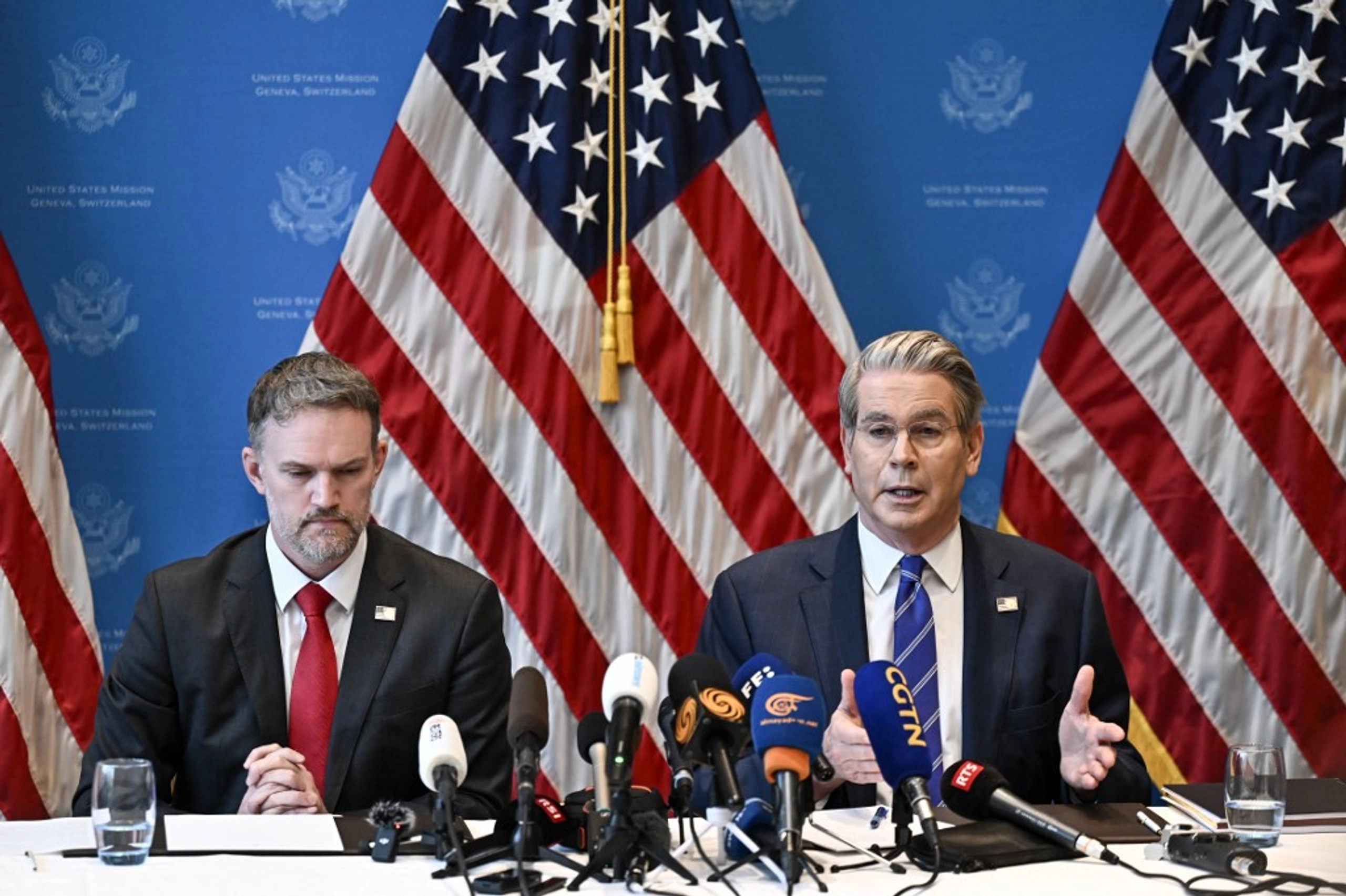
US Treasury Secretary Scott Bessent described the weekend discussions with Chinese Vice Premier He Lifeng and international trade representative Li Chenggang as “productive” and “robust”.
“Both sides showed a great respect,” Bessent told reporters.
Trump had imposed duties of 145 percent on imports for China last month — compared to 10 percent for other countries in the global tariff blitz he launched last month.
Beijing hit back with duties of 125 percent on US goods.
The United States agreed to lower its tariffs on Chinese goods to 30 percent while China will reduce its own to 10 percent.
China hailed the “substantial progress” made at the talks, which were held at the discreet villa residence of Switzerland’s ambassador to the United Nations in Geneva.
“This move… is in the interest of the two countries and the common interest of the world,” the Chinese commerce ministry said, adding that it hoped Washington would keep working with China “to correct the wrong practice of unilateral tariff rises”.
Stock markets and the dollar, which tumbled after Trump unleashed his global tariff blitz in April, rallied after the announcement.
– The Equivalent of an Embargo –
“The consensus from both delegations this weekend is neither side wants a decoupling,” U.S. Treasury Secretary Scott Bessent said after talks with Chinese officials in Geneva. “And what had occurred with these very high tariffs … was the equivalent of an embargo, and neither side wants that.”
The meetings were the first face-to-face interactions between senior U.S. and Chinese economic officials since Trump returned to power.
China’s vice premier, He Lifeng, told reporters at China’s mission to the World Trade Organization on Sunday that the talks were “candid, in-depth and constructive.”
“The meeting achieved substantial progress and reached important consensus,” He said.
After Trump hiked tariffs on Chinese goods to 145%, China hit back by putting export curbs on some rare earth elements, vital for U.S. manufacturers of weapons and electronic consumer goods. Beijing raised tariffs on U.S. goods to 125%.
Andrew Gossage, CEO of Ultimate Products, which owns homeware and appliance brands that sell China-manufactured products mainly to the UK and Europe, said Chinese manufacturers will still prioritize European customers even if U.S. tariffs drop to pre-Trump levels.
“The U.S. has definitely gone into unreliable boyfriend territory when it comes to the attitude of the Chinese manufacturers to that market,” he said. “So they’re seeing European, UK markets as more rational, more reliable, less volatile.”
Shares in European firms hit by the trade war rallied after the deal. Shipping company Maersk (MAERSKb.CO), opens new tab was the biggest gainer in Europe, up more than 12%. It warned last week that container volumes between the U.S. and China had plunged due to the dispute.
“We hope it can lay the foundation for the parties to also reach a permanent deal that can create the long-term predictability our customers need,” Maersk said in a statement.
Shares in luxury firms rose, with LVMH (LVMH.PA), opens new tab up 7.4% and Gucci-owner Kering (PRTP.PA), opens new tab up 6.7%.
Bessent told U.S. media that much work remained to be done, and neither a place nor time for a next meeting had been set.
“Over the next 90 days, we have a mechanism to meet with the Chinese trade delegation,” he told MSNBC. “We will be discussing tariffs, non-tariff trade barriers, currencies and their subsidies of labor and capital, and how we can open up China to American businesses.”
He said Chinese officials had understood the importance of addressing the fentanyl crisis and for the first time appeared to be working to halt the flow of precursor drugs into the U.S.
READ ALSO: UK announces end to overseas social care recruitment
Trump levied the tariffs in part after declaring a national emergency over fentanyl entering the U.S.
– Fentanyl ‘cooperation’ –
The US tariff rate remains higher than China’s because it includes a 20-percent levy put in place over US complaints about Chinese exports of chemicals used to make fentanyl, US Trade Representative Jamieson Greer told reporters.
“Those remain unchanged for now,” he said, adding though that “both the Chinese and United States agreed to work constructively together on fentanyl and there is a positive path forward there as well”.
In their joint statement, the two sides agreed to “establish a mechanism to continue discussions about economic and trade relations”.
“I think we leave with a very good mechanism to avoid the unfortunate escalations,” Bessent said, noting that the tariffs had essentially created a trade “embargo” between the two superpowers.
He added that “the nature of what has happened since April 2 could have been avoided if we had had this kind of mechanism in place”.
The Chinese commerce ministry said “the two sides will conduct rolling consultations on a regular or ad hoc basis in China, the US or agreed third countries”.
– ‘Uncertainties’ remain –
Zhiwei Zhang, president and chief economist at Pinpoint Asset Management, said in a note the outcome of the weekend meeting was particularly a “success” for Beijing.
“China took a tough stance on the US threat of high tariffs and eventually managed to get the tariffs down significantly without making concessions,” he said.
Wang Wen, Dean of Chongyang Institute for Financial Studies at Renmin University of China, said the agreement had “exceeded expectations”, hailing “the biggest easing of tensions… since the global tariff war” began.
He cautioned though that “uncertainties” remained, warning that without progress over the next 90 days “it is possible that the tariff war will resume”.
The trade dispute between Washington and Beijing has rocked financial markets, raising fears the tariffs would rekindle inflation and cause a global economic downturn.
The Geneva meeting came days after Trump unveiled a trade agreement with Britain, the first with any country since he unleashed his flurry of global tariffs.
The head of the World Trade Organization, Ngozi Okonjo-Iweala, praised the talks on Sunday as a “significant step forward” that “bode well for the future”.
“Amid current global tensions, this progress is important not only for the US and China but also for the rest of the world, including the most vulnerable economies,” she added.