


Lagos–U.S. Lawmakers issued the strongest warning yet to President Bola Tinubu, accusing his administration of enabling a wave of anti-Christian violence and insisting that Washington will “hold him responsible” if the killings continue.
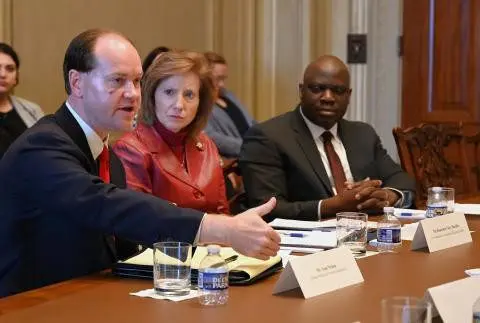
The warning came during a joint Capitol Hill briefing led by Rep. Mario Díaz-Balart (R-FL), Vice Chair of the House Appropriations Committee, and members of the House Foreign Affairs Committee.
Lawmakers described the violence not as “banditry,” but as systematic, religiously targeted persecution of Christians across Nigeria’s north and Middle Belt.
“This is not a farmer–herder conflict. This is religious cleansing,” said Rep. Brian Mast (R-FL), chairman of the House Foreign Affairs Committee. “Whether it’s Boko Haram, ISWAP, or radicalized Fulani militants, the goal is the same: drive Christians from their ancestral lands and impose extremist ideology.”
The briefing follows President Donald Trump’s October 31 directive redesignating Nigeria as a Country of Particular Concern (CPC), Washington’s highest global ranking for religious-freedom violations.
A Survivor’s Story That Silenced the Room
Earlier on November 20, lawmakers heard testimony from Msurshima Apeh, a widow from Yelewata in Benue State who survived a massacre that killed more than 200 villagers earlier this year.
She described how militants stormed the displacement camp where her family slept.
“When we went to sleep that night around 9 pm, the Fulani terrorists attacked us,” she said. “I climbed a tree where I was able to hide and I watched my five children being slaughtered beneath me.”
Her testimony drew visible emotion from members of Congress, who repeatedly questioned why Nigerian security forces failed to respond despite early warnings.
Experts to Congress: Sharia Law and Hisbah Police Are Fueling Persecution
Dr. Ebenezer Obadare, Senior Fellow for Africa Studies at the Council on Foreign Relations, told lawmakers that Nigeria cannot end its security crisis unless the Tinubu administration dismantles the systems enabling religious extremism.
He identified two central drivers:
• Jihadist networks including Boko Haram and ISWAP
• Islamic legal systems – Sharia law and Hisbah morality police operating across 12 northern states
“The deadliest threat to Nigeria today is jihadist terror,” he said. “Any proposal that does not prioritize eliminating Boko Haram is a non-starter.”
Obadare urged U.S. lawmakers to pressure Abuja to take two unprecedented steps:
• Declare Sharia law unconstitutional nationwide
• Disband all state-backed Hisbah religious-enforcement groups
He added that Trump’s recent CPC redesignation had already forced Abuja to announce new police recruitment and renewed airstrikes but warned that these measures “fall far short of what is needed.”
“Washington must keep up the pressure,” he said.
‘This is religious cleansing’ — U.S. Congress
Chairman Chris Smith (R-NJ), who leads the House Foreign Affairs Africa Subcommittee, said the Nigerian state is failing at its most basic responsibility.
“The Nigerian government has a fundamental, constitutional obligation to protect its citizens; however, the perpetrators of this persecution operate with complete impunity,” Smith said. “Nigeria is trying to run out the clock. We cannot allow this to happen.”
Rep. Brian Mast (R-FL), chairman of the House Foreign Affairs Committee, rejected what he called “the misleading narrative” that the killings stem from farmer–herder disputes.
“This is a targeted campaign of religious cleansing,” Mast said. “This is not merely ‘inter-communal violence’ or a ‘resource conflict,’ as many claim.
Rep. Riley Moore (R-WV) added, “The world will no longer turn a blind eye to the persecution of Christians in Nigeria.”
READ ALSO: Trump’s govt announces visa ban for terrorism financers, supporters, others
‘Early warnings are ignored. People die.’ – USCIRF
Vicky Hartzler, Chair of the U.S. Commission on International Religious Freedom (USCIRF), condemned Nigeria’s security agencies for ignoring intelligence warnings ahead of mass killings.
“Villagers call for help before an attack. During the attack, calls go unanswered. Afterward, there is no investigation,” Hartzler said. “This is unacceptable.”
She referenced the November 22 abduction of 303 children and 12 teachers from St. Mary’s Catholic School in Niger State, calling it “further evidence of a collapsing security environment.”
U.S. Lawmakers set Tough Conditions for Nigeria
Several members of Congress outlined explicit expectations for the Tinubu government, including:
• Disarm all armed groups in the north and Middle Belt
• Return displaced Christian families to their lands
• Prosecute attackers regardless of religion or ethnicity
• Reform blasphemy laws and all Sharia-based criminal statutes
• End security failures where early warnings go unaddressed
Failure to comply, they warned, could lead to:
• Targeted U.S. sanctions
• Suspension of military assistance
• Restrictions on security cooperation
• A reduction or freeze of American aid
“Nigeria is out of time,” Rep. Díaz-Balart said. “The killings must stop, and the government must act now.”
Numbers That Show a Nationwide Crisis
According to the Observatory for Religious Freedom in Africa (ORFA):
• 16,769 Christians have been killed in Nigeria between 2019 and 2023
• More than 11,185 Christians abducted in the same period
• Massive displacement continues across Kaduna, Plateau, Benue, and Niger states
U.S. lawmakers say these numbers reveal a pattern of persecution that Abuja has consistently denied.
What comes next?
House appropriators are preparing a full investigative report for President Trump, who has signaled that the U.S. may halt aid or take unilateral action if Nigeria fails to curb the killings.
Congress is also pushing for:
• Mandatory U.S.–Nigeria security reforms
• Direct pressure on Aso Rock to end impunity
• Oversight of how Nigerian forces use American military assistance
• A national strategy to return displaced Christian families home

