
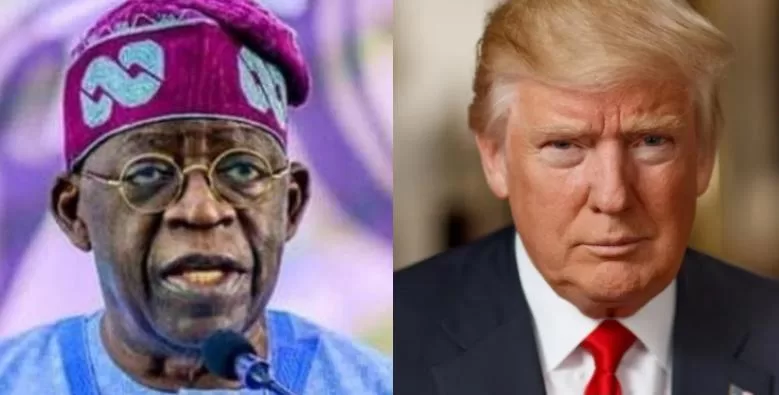
A threat of military action by United States President Donald Trump over the alleged persecution of Christians has sharply divided Nigeria’s leadership.
While the government rejected the claim, the move has exposed sharp fractures over national sovereignty, security failures, and simmering religious tensions.
Stakeholders, like Mr Dolapo Oyedokun, a political communication scholar based in the United States with expertise in terrorism and counter-terrorism, said Trump’s threat was a call for urgent action by the Nigerian government, a call already acknowledged by the Presidency and the Ministry of Foreign Affairs.
Trump had announced on Saturday via his Truth Social platform that his directive to the Pentagon to prepare for a possible military invasion of Nigeria was aimed at halting what he described as the persecution and massacre of Christians in the country.
In a statement laced with fiery rhetoric, Trump warned that “if the Nigerian Government continues to allow the killing of Christians, the USA will immediately stop all aid and assistance and may very well go into that now disgraced country, ‘guns-a-blazing,’ to completely wipe out the Islamic Terrorists who are committing these horrible atrocities.
“I am hereby instructing our Department of War to prepare for possible action. If we attack, it will be fast, vicious, and sweet, just like the terrorist thugs attack our cherished Christians!”
The US leader’s position, coming shortly after Nigeria was designated a “country of particular concern,” was reportedly based on claims that the Nigerian government had failed to curb attacks and tyranny against citizens, especially Christians.
Reacting, President Bola Ahmed Tinubu, through the Ministry of Foreign Affairs, rejected Trump’s assertions, stressing that “Nigeria opposes religious persecution and does not encourage it. Nigeria is a country with constitutional guarantees to protect citizens of all faiths.”
Foreign Affairs spokesperson Kimiebi Ebienfa reaffirmed that Nigeria remained committed to defending all citizens “irrespective of race, creed or religion,” adding, “Like America, Nigeria has no option but to celebrate the diversity that is our greatest strength.”
However, Pentagon Chief Pete Hegseth reinforced Trump’s order, stating: “The Department of War is preparing for action. Either the Nigerian Government protects Christians, or we will kill the Islamic Terrorists who are committing these horrible atrocities.”
The Tinubu administration has indicated plans for dialogue between both governments to exchange views on counterterrorism strategies and efforts to curb insecurity. The Presidency said Tinubu had already directed the new service chiefs to intensify operations against terrorists, reiterating that Nigerians expect “no more excuses, but results.”
Special Adviser to the President on Policy Communication, Daniel Bwala, suggested that both leaders might meet soon to discuss Nigeria’s security situation.
Daniel Bwala, said it would be diplomatically unacceptable for the United States to undertake any military operation in Nigeria without the explicit consent of the Federal Government.
Speaking in an interview with the BBC World Service on Monday, Bwala stressed that Nigeria remains a sovereign nation and that any form of foreign intervention in its internal security issues must be collaborative and respectful of its territorial integrity.
This came after US President Donald Trump named Nigeria a “country of particular concern” over the alleged persecution of Christians.
READ ALSO: NSA, service chiefs meet over Trump’s military threat to Nigeria
Trump warned that Nigeria could lose US aid if it fails to tackle insecurity.
He also threatened to deploy America’s “Department of War” against terrorist groups he claimed were targeting Christians in Nigeria.
Reacting, Bwala said Trump’s comments were largely misinterpreted, expressing confidence that the matter would be clarified when Tinubu meets with his US counterpart in the coming days.
He also commended Trump for authorising arms sales to Nigeria during his first term, describing it as a goodwill gesture.
He dismissed claims of a “Christian genocide” in Nigeria, noting that insecurity affects citizens across religious lines.
“We are grateful to President Donald Trump because during his first term, he approved arms sales that strengthened Nigeria’s fight against insurgency.
“In his second term, he has again shown interest in supporting the fight against Boko Haram, which we welcome—but such efforts must rely on credible intelligence, not isolated reports or social media narratives,” Bwala said.
Bwala insisted that any such action would only be legitimate if done jointly with the Nigerian government.
“If it’s a joint operation with Nigeria, that’s acceptable. But diplomatically, it is wrong to invade a sovereign nation without collaboration—especially one that remains a strategic partner in the fight against insecurity.
“Unilateral intervention only happens when there is evidence that a government is complicit in a crisis. That is certainly not the case in Nigeria,” he said.
Meanwhile, Brig.-Gen. Sani Kukasheka Usman (rtd), former Director of Public Relations of the Nigerian Army, warned that if United States President Donald Trump’s threat were genuine, it would have grave diplomatic, security, and internal stability implications for Nigeria.
Analysing the development from a security perspective, Usman said the threat could disrupt the country’s counter-insurgency efforts and other internal security operations by diverting attention and resources from domestic stability to external defence and diplomatic engagements.
While doubting Nigeria’s capacity to withstand such pressure, he stated: “This shift would likely complicate ongoing operations against insurgent groups such as Boko Haram, ISWAP, and various bandit and kidnapping networks.
“Furthermore, the situation could also strain the vital intelligence and military cooperation between Nigeria and the United States, a collaboration that has been instrumental in providing intelligence sharing, training, and logistical support in Nigeria’s fight against terrorism.
“A breakdown in this partnership might weaken the country’s operational effectiveness and diminish its capacity to respond swiftly to emerging threats.” He expressed concern that there could be collateral damage if the US carried out its threat, warning that the consequences could be grave and might worsen relations between Christians and Muslims in the country.
“Such tensions,” he noted, “could erode social cohesion and provide fertile ground for radical groups to exploit grievances and recruit followers. The rhetoric of ‘genocide against Christians’ could also inflame religious polarisation within Nigeria, deepening mistrust between faith communities, amplifying extremist narratives, and possibly sparking religious conflict.”
On the diplomatic front, Usman said Nigeria would face the difficult task of countering misinformation, defending its sovereignty, and reassuring both domestic and international stakeholders of its commitment to religious freedom and human rights.
He added that the government must engage in strategic communication and robust diplomacy to manage perceptions and maintain international credibility. “Such rhetoric poses a serious threat to peace, security, and cohesion, fuelling internal divisions, weakening coordinated security responses, and politicising religious identities. This, in turn, would make it significantly harder for Nigeria to live in peace and effectively combat terrorism, banditry, and extremism.”
Islamic cleric Sheikh Ahmad Gumi has called on President Bola Tinubu to take firm action against former United States President Donald Trump over his alleged threat of military action against Nigeria.
In a post on his verified Facebook page yesterday, Gumi described Trump’s remarks as an insult to Nigeria’s sovereignty and urged the Federal Government to respond immediately.
“For Trump to threaten a sovereign country with military attack is a profound disrespect to our authority, but we can rise above it,” he wrote.
The cleric advised the government to summon the US ambassador to demand a retraction, warning that failure to do so should result in a diplomatic break.
“President Tinubu should summon the US ambassador; they either retract their threats or we sever diplomatic ties with this irresponsible regime,” Gumi stated. He further urged Nigeria to seek alternative partners for its economic and military development.
“There are lots of other options for our economic expansion and military alliance,” he added.
However, respondents, like former Military Governor of Ondo State, Chief Olabode George, said, “This is not a good development…It will further worsen our economy and make the ongoing hardship even more severe.” George also dismissed Trump’s claims of religious persecution as lacking a factual basis.
“I can volunteer to take the American Consul in Nigeria around to show him that Christians and Muslims coexist peacefully in several parts of the country,” he said. “This is contrary to the damaging propaganda some politicians are spreading.”
The Coordinator of the Human Rights Writers Association of Nigeria (HURIWA), Comrade Emmanuel Onwubiko, said former US President Donald Trump should make good his threat to bomb terrorists, stressing, however, that such military action should be specifically directed at Boko Haram, ISWAP, and terrorist groups operating in the forests of Kwara, Niger, Kaduna, Katsina, and Zamfara states.
“We believe that the Nigerian government has failed to show decisive action against terrorists, and this lack of commitment to eradicate them is the reason Turji Bello and several other terrorist masterminds declared wanted by the Defence Headquarters are still in firm control of their territories across the North-West.
“We honestly think that President Trump should immediately strike against these terrorists, but we do not support regime change, which does not follow constitutionally allowed processes such as periodic elections. HURIWA believes that what has emboldened the terrorists to escalate their attacks against Christians is the fact that Nigeria is headed by both a Muslim President and a Muslim Vice President, while all other strategic ministries like Defence are also led by Muslims,” the group said.
HURIWA further alleged that the Federal Government’s refusal to acknowledge what it described as “genocide” against Christians in Plateau, Benue, Taraba and Southern Kaduna states stemmed from the silence of ministers who, being Muslims, “pay little or no attention to it.”
According to the group, “The ministers of foreign affairs and information are Muslims, and these two are shaping the Federal Government’s narrative against the reality of persistent and targeted attacks on Christians in the Middle Belt.
“The USA should also consider providing technical assistance to the Nigerian military to eliminate terrorists, especially those who have openly declared their intent to wipe out Christians in Nigeria, such as Boko Haram, ISWAP and the Lakurawas, among others. The current administration has failed to defeat them decisively due to politics and indecisiveness.”