
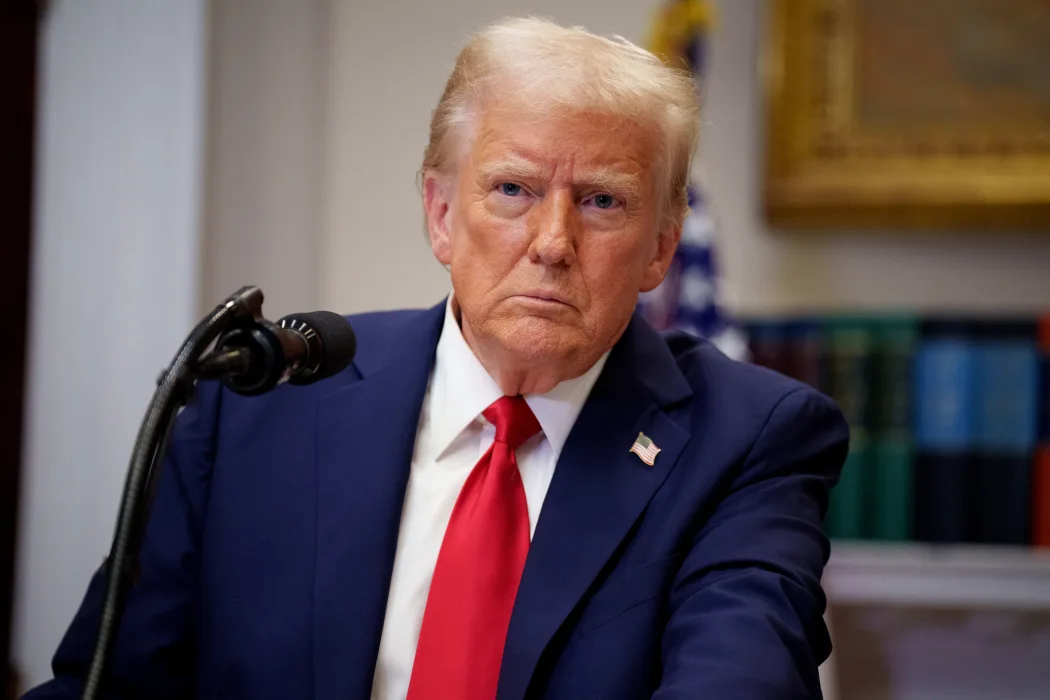
United States (US) President Donald Trump has threatened an additional 10 percent tariff on countries aligning themselves with the ‘BRICS’, which is expected to burden Nigeria’s economy.
“Any Country aligning themselves with the Anti-American policies of BRICS, will be charged an ADDITIONAL 10% Tariff. There will be no exceptions to this policy,” Trump wrote on his Truth Social platform on Sunday, July 7.
The word BRICS was coined from the names of the pioneer nations of Brazil, Russia, India, China, and South Africa, which came together under an informal grouping of emerging economies. In 2024, the group expanded to include Iran, Egypt, Ethiopia, and the United Arab Emirates (UAE), while Indonesia further became the first Southeast Asian member of the bloc.
In January, Nigeria joined Belarus, Bolivia, Cuba, Kazakhstan, Malaysia, Thailand, Uganda, and Uzbekistan as BRICS’ ninth partner country after the alliance’s partner-country category was created at the 16th BRICS Summit in 2024.
Nigeria was formally admitted in January 2025, a status that allows participation in BRICS meetings, summits, and initiatives, contributing to discussions and official documents. The partner status is an upgrade from its previous guest status, which the country had enjoyed over the years.
President Bola Tinubu arrived in Rio De Janeiro, Brazil, on Saturday for the 17th summit of BRICS countries. He is attending at the invitation of President Luiz Inacio Lula da Silva of Brazil, on the strength of Nigeria’s status as a ‘partner country’—a membership category short of full status.
The bloc aims to boost countries’ international standing and challenge the US and Western European powers.
Trump lashed out at the 11 nations of BRICS, vowing to impose an extra 10 per cent tariff on the grouping. His 10 percent additional tariff threat comes following the BRICS leaders’ meeting in Brazil for a two-day summit, which started on Sunday, July 6, to reaffirm the bloc’s commitment to multilateral diplomacy.
It also comes as the US begins formally notifying affected countries of the tariffs it had declared earlier this year, with letters and deals set to roll out on Monday. Trump’s fresh threat comes as BRICS leaders at the summit on Sunday criticised Trump’s “indiscriminate” import tariffs and recent Israeli-US strikes on Iran.
Voicing “serious concerns about the rise of unilateral tariff” measures, BRICS members said the tariffs risked hurting the global economy, according to a summit joint statement. Trump fired back at the bloc directly on social media Sunday night.
In April, Trump threatened allies and rivals alike with a slew of punitive duties, before offering a months-long reprieve in the face of a fierce market sell-off. He has warned he will impose unilateral levies on partners unless they reach “deals” by August 1.
The ICIR reports that immediately after Trump assumed office in January, he imposed a series of import taxes on goods from other countries, including a 14 per cent tariff on Nigeria.
Baring the impact this will have on its economy, the Nigerian government had pointed out that the US tariffs would hurt its oil and non-oil export businesses.
According to the ICIR report, the Minister of Industry, Trade, and Investment, Jumoke Oduwole, said it could potentially disrupt trade relations and affect the competitiveness of Nigerian products in the US market, especially in sectors reliant on market access and price competitiveness. She noted that a significant portion of over 90 per cent of Nigeria’s exports, comprising crude petroleum, mineral fuels, oils, and gas products, would be affected.
Nigeria’s economy has taken a tumble since 2023, with headline inflation reaching 28.92 per cent in December 2023 in relative to 18.85 per cent in 2022. It rose further by 34.2 per cent in June 2024. It, however, dropped to 27.50 per cent recently, according to the Central Bank of Nigeria (CBN).
The rate has been maintained at this level by the CBN’s Monetary Policy Committee for two consecutive meetings, including the one held in May 2025.
The apex bank has had to make recent policy changes, including the removal of fuel subsidies and the floatation of the naira’s exchange rate, aimed at stabilising the economy and boosting growth. While Nigeria holds the position of Africa’s largest economy, it faces challenges such as high inflation, a fluctuating global oil market, and a need for diversification.
The country’s GDP has seen fluctuating growth rates in recent years, with an average of 2.3 per cent in the decade leading up to 2023.
An extra 10 per cent tariff from the US could have a high impact on Nigeria’s exports to the US. Nigeria’s primary export to the United States is crude oil, making up a significant portion of their bilateral trade.
Over 90 per cent of Nigeria’s exports to the US consist of crude oil and related petroleum products. A smaller portion of exports to the US includes items like fertiliser, agricultural commodities, and manufactured goods.
While the US is a major trading partner for Nigeria, Nigeria represents a relatively small percentage of the total trade volume of the US.
Recent reports indicate that US tariffs on non-oil exports from Nigeria could negatively impact Nigeria’s efforts to diversify its export base. Again, Nigeria’s heavy reliance on crude oil exports makes it vulnerable to price fluctuations and shifts in global demand.