
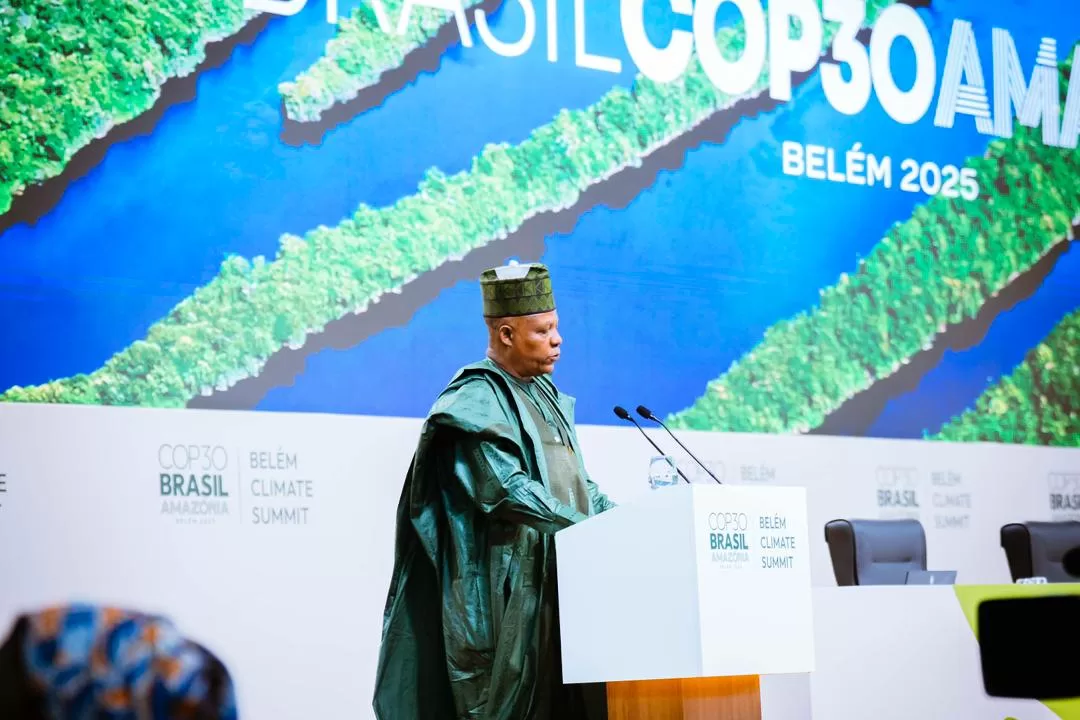
Vice President Kashim Shettima has called on world leaders to move from rhetoric to measurable action in tackling climate change, urging that the 30th Conference of Parties (COP30) be remembered as the point where “the world moved from pledges to performance, from ambition to action, and from dialogue to delivery.”
Representing President Bola Ahmed Tinubu at the Leaders’ Climate Summit in Belém, Brazil, Shettima said Nigeria remains committed to global climate goals and has set an ambitious target of cutting carbon emissions by 32% by 2035. He said this is backed by the launch of the National Carbon Market Framework and the Climate Change Fund, two key pillars of the nation’s climate finance architecture.
According to the Vice President, the initiatives are designed to attract billions of dollars in clean energy and adaptation investments, while ensuring that affected communities benefit directly. “Our renewed climate agenda is not just an aspiration, but a solemn national commitment to preserve the planet for future generations,” he said.
Shettima warned that the Earth “speaks in the language of loss and warning,” stressing that nations must listen to the planet’s distress signals and take decisive steps to protect it. “No nation can finance climate ambition with goodwill alone,” he added. “We need a reliable and equitable architecture that recognises the realities of developing nations and empowers them to deliver on global commitments.”
The Vice President reaffirmed that Africa is not part of the problem but a vital part of the solution, noting that the continent can lead in carbon capture, renewable energy expansion, and emission monitoring. “Nigeria is ready to work with all nations to build a fairer, greener, and more resilient world,” he said.
READ ALSO: Edun: Nigeria’s Economy Rebounds, Reforms Boost Investor Confidence
He explained that the National Carbon Market Framework will enable Nigeria to generate, trade, and retire carbon credits transparently in line with Article 6 of the Paris Agreement. The Climate Change Fund, he said, will channel proceeds to communities affected by floods, droughts, and desertification.
In addition, the government has developed a five-year Carbon Market Roadmap, which will guide the establishment of an Emissions Trading System and a Carbon Tax Regime, bolstered by fiscal incentives to promote industrial innovation.
Shettima also highlighted Nigeria’s Third Nationally Determined Contribution (NDC), validated and submitted in September 2025, outlining comprehensive strategies across key sectors such as energy, agriculture, transport, waste management, and industry. He reaffirmed that Nigeria’s Decade of Gas Strategy will power the country’s transition, balancing natural gas use with expanded solar and off-grid electrification for sustainable rural development.
UN Secretary-General António Guterres, in his remarks, lamented the world’s failure to keep temperatures below the 1.5°C target, warning that the consequences of overshooting could push ecosystems beyond recovery and expose billions to unliveable conditions. “Every fraction of a degree means more hunger, displacement, and loss—especially for those least responsible,” he said, urging world leaders to act “with speed and scale.”
Also speaking, Brazil’s President Luiz Inácio Lula da Silva emphasized that the fight against climate change requires “collective effort” and the inclusion of indigenous voices. “Climate justice is aligned with fighting hunger and poverty, and the struggle against inequality,” he said, noting that COP30’s theme—Collective Efforts—was chosen to inspire action from governments and citizens alike.
In his address, Prince William, representing King Charles III, urged leaders to act decisively to safeguard the planet. “Our children and grandchildren will stand on the shoulders of our collective action,” he said. “Let us meet this moment not with hesitation, but with courage and collaboration.”
Vice President Shettima’s call echoed across the summit: the era of pledges must give way to the age of performance—where nations act not out of obligation, but out of shared responsibility for humanity’s survival.