
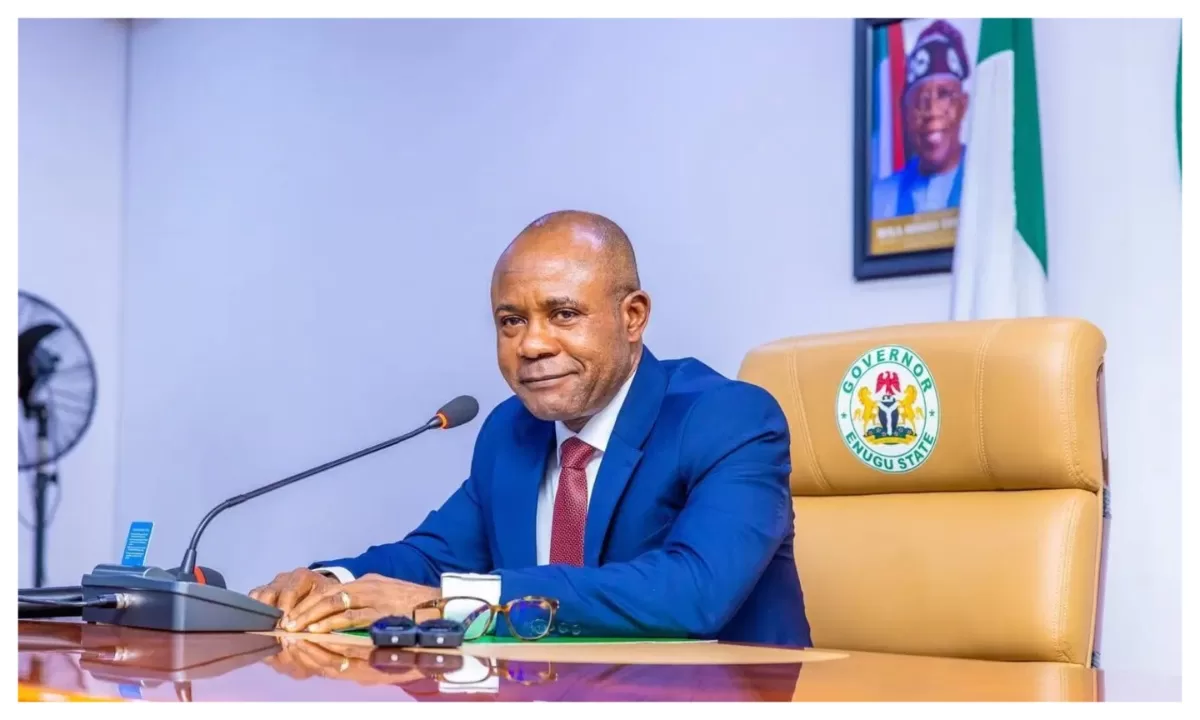
In Nigerian politics, months occasionally come along that redraft political maps, reorder power blocs, and crystallise leadership identities. For Enugu State, October marked one of those rare turning points, driven by the bold steps and developmental momentum of Governor Peter Ndubuisi Mbah.
The month began with the familiar rhythm of governance roads being paved, schools operationalising new digital systems, new security assets being deployed, and the state’s investment climate tightening its grip on national headlines. But it would not end that way.
By mid-October, Mbah would shake the political establishment with one of the most consequential defections in recent South-East history: his move from the Peoples Democratic Party (PDP) to the ruling All Progressives Congress (APC).
For a region long considered a PDP fortress and for a state that has known a specific political rhythm for decades, the moment ruptured expectations. It also crowned a month of governance momentum and strategic repositioning that may shape Enugu’s future for years to come.
Those who follow governance metrics already agree: Peter Mbah’s leadership has carried a technocratic urgency since his first days in office. October only amplified the pattern.
Across Enugu metropolis and satellite communities, road expansion continued at record pace. Street Lighting projects once a novelty expanded further, giving the city a fresh metropolitan glow. Waste evacuation, previously a chronic challenge, has become increasingly structured and tech-driven.
Security operations intensified under the state’s modern Command-and-Control system, integrating surveillance, rapid response units, and inter-agency synergy. For residents, the result was tangible: safer streets, reduced crime pockets, and a modern policing approach rare in sub-national Nigeria.
In education, the governor’s flagship Smart School initiative matured another layer. Classrooms equipped with digital boards, technology labs, and AI-enabled learning modules are gradually transforming the learning experience for Enugu children. Mbah has repeatedly argued that “the future is coded in technology,” and his education reforms reflect a leader intent on preparing the children of coal-city for a post-oil global economy.
Meanwhile, investors have continued to set their sights on Enugu, encouraged by the administration’s ease-of-doing-business reforms, digital land registry modernization, and a governor unafraid to speak the language of global markets. Analysts note that Enugu today presents one of the clearest sub-national investment blueprints in the country.
READ ALSO: Court Stops 2025 PDP’s National Convention
Yet, no event in October overshadowed Mbah’s political pivot.
His defection to the APC was not just a shift, it was a tremor.
For decades, Enugu has been the spiritual and electoral home of the PDP in the South-East. To see the state’s sitting governor stand under the broom symbol, flanked by federal power brokers, spoke volumes not merely of personal strategy, but of a tectonic realignment.
Mbah himself framed the move as a development-driven decision: a need to align Enugu’s renaissance with federal economic power and reform momentum.
“We must connect Enugu to the centre to fast-track development,” he said, echoing a philosophy familiar in Nigerian federal politics: alignment breeds acceleration.
Vice President Kashim Shettima welcomed him warmly, describing Mbah as a “visionary technocrat whose work speaks louder than politics,” and signalling a new chapter of cooperation between Abuja and Enugu.
Beyond symbolism, the shift triggered ripples across the state:
Local political structures tilted in unison with the governor
Assembly members and federal legislators aligned with him
Traditional and community leaders publicly endorsed his decision
Grassroots blocs recalibrated for strategic continuity
In a region where opposition voices often lament marginalisation from federal power, Mbah positioned himself as a bridge rather than a bystander.
Political commentators called it “a smart chess move.” Critics branded it opportunistic. But even detractors concede one point: Mbah switched from a position of performance strength, not desperation.
Governance seasons have rhythms. Some simmer quietly; others erupt with transformational energy. October was Mbah’s eruption month a blend of physical development, policy momentum, and bold political repositioning.
As Enugu enters the last quarter of the year, a new narrative is already written in its skyline, classrooms, and political map. The state is no longer simply a stronghold of old regional loyalties; it is now a strategic player in national power dynamics, guided by a governor determined to transform it into an economic powerhouse and a hub of modern governance.
Whether one views his move as political pragmatism or visionary strategy, one thing is undeniable: Peter Mbah has chosen audacity over caution.
And in the business of building futures, sometimes audacity is the only currency that counts.
In the coal-rich heart of Enugu, a new fire is burning not of black dust and old industry, but of political reinvention, modern governance, and a state stepping boldly into the national spotlight.