
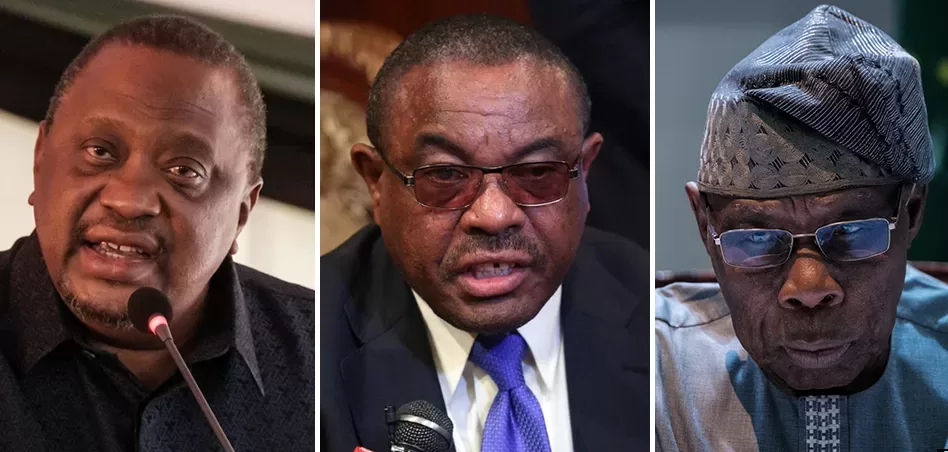
Eastern and southern African regional blocs have appointed former leaders from Ethiopia, Kenya and Nigeria to oversee their peace process for the Democratic Republic of Congo where fighting has intensified in the east of the country.
The East African Community (EAC) and Southern African Development Community (SADC) have come together in recent weeks in an attempt to bring peace to eastern DRC, where the Rwanda-backed M23 armed group has seized large swathes of territory, triggering a humanitarian crisis.
The two blocs agreed in a summit on February 8 to merge two separate peace processes — based in Luanda and Nairobi — that were operating before the latest escalation of violence.
Late Monday, they issued a statement that they had appointed ex-Kenya president Uhuru Kenyatta, ex-Ethiopia prime minister Hailemariam Desalegn and ex-Nigeria president Olusegun Obasanjo as “facilitators” of this new peace process.
It said the key goals included an “immediate and unconditional ceasefire” as well as humanitarian supplies and securitisation of the airport at Goma, one of the key cities taken by M23.
The statement said the EAC and SADC would hold a ministerial meeting on Friday to “work on the details of the ceasefire”.
READ ALSO: ECOWAS inaugurates EU-funded programme on migration
The EAC and SADC agreed at a summit on February 8 to merge two separate peace processes — based in Luanda and Nairobi — that were operating before the latest escalation of violence.
But numerous calls for a ceasefire have so far gone unheeded as the M23 continues its advance, meeting little resistance from the Congolese army.
M23 fighters — which UN experts say are backed by thousands of Rwandan soldiers — took control of South Kivu provincial capital Bukavu just over a week ago, after capturing Goma, the capital of North Kivu and main city in the country’s east, late last month.
“The message has to be conveyed very clearly: any armed group, any armed forces, any allies to armed groups or armed forces don’t have a blank cheque,” Khan said.
The statement from the EAC and SADC said their key goals were an “immediate and unconditional ceasefire” as well as humanitarian supplies and securitisation of the airport at Goma.
It said they would hold a ministerial meeting on Friday to “work on the details of the ceasefire”.
DRC Prime Minister Judith Suminwa Tuluka said Monday that “more than 7,000” people have been killed in the region since January. The numbers could not be independently verified.
“The security situation in eastern DRC has reached alarming levels,” she told the United Nations Human Rights Council in Geneva.
The UN reported at the beginning of February more than 3,000 deaths since January 26 in east DRC around the time of the M23 offensive which saw the group capture Goma.
The UN’s humanitarian agency OCHA said Monday that as of February 14 there had been 842 deaths in hospitals in Goma and the outskirts of the city.
The day after Bukavu was taken, life in the city “returned to normal, but local sources reported an increase in crime”, particularly burglaries by armed men, OCHA said.
“This increase in crime is due to the circulation of weapons abandoned by the soldiers” of the DRC army, it added, saying this “raises the risk of an increase of insecurity in the province”.