


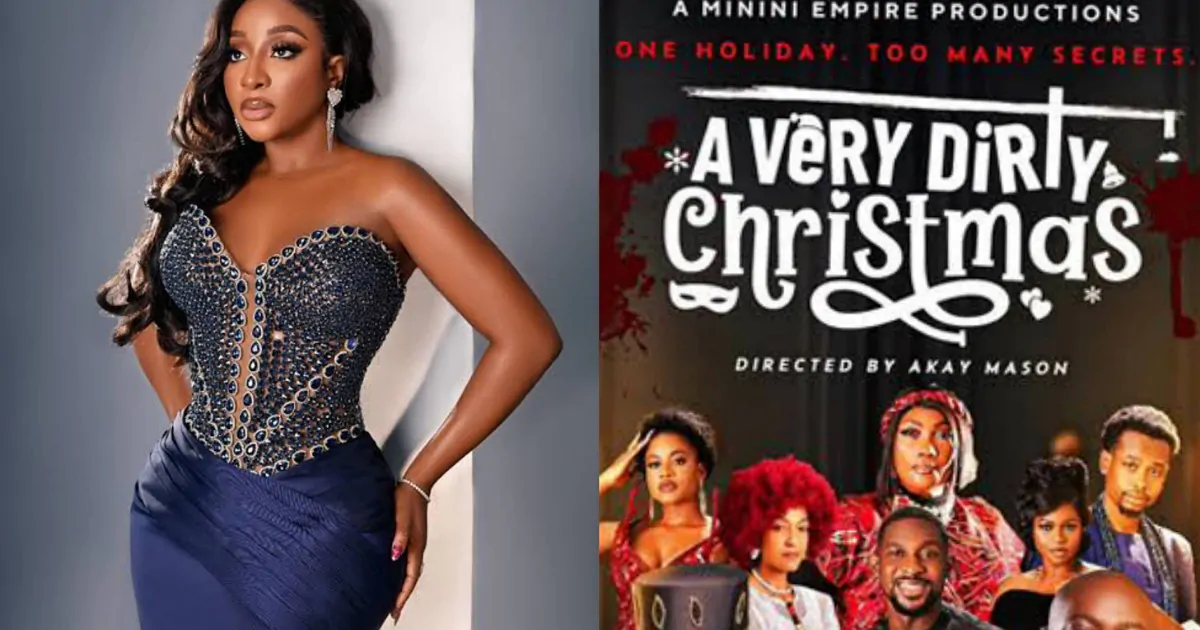
Actress and film producer Ini Edo has responded to criticism from the Christian Association of Nigeria (CAN) over the title of her film, ‘A Very Dirty Christmas.’
In a statement, Ini Edo explained that the title was never meant to demean Christianity or disrespect the Christmas season.
She emphasised that the film aims to spark reflection and conversation, and that all necessary approvals were obtained from regulatory bodies, including the National Film and Video Censors Board (NFVCB) and Nigerian Copyright Commission (NCC).
Ini Edo, a self-described devout Christian, assured that she would never knowingly create content that disrespects her faith or the Christmas season.
She described the title as metaphorical, reflecting the story’s themes and realities.
The statement reads, “Art, at its highest form, is meant to provoke thought, spark conversation, and reflect the complexities of human experience. It is in this spirit that *A Very Dirty Christmas* was created.
“Prior to the release of this film, all legal and regulatory requirements governing motion pictures in Nigeria were fully complied with, including securing the appropriate approval from the National Film and Video Censors Board (NFVCB), Nigerian Copyright Commission (NCC), amongst others. At no time was there any intention to demean, ridicule, or dishonour Christianity, the Christmas season, or the values held dear by millions of Nigerians.
READ ALSO: CAN condemns Ini Edo’s ‘Dirty Christmas’ film, demands apology
“I am a devout Christian. My faith is deeply personal to me, and it guides my values, my choices, and my life. I would never knowingly create or associate myself with any work that seeks to misrepresent, disrespect, or undermine my religion or the essence of Christmas.
“The title of the film is metaphorical, reflecting the story being told and the realities explored within it. Christmas, while sacred, is also a season that often reveals the contrast between appearance and truth, joy and struggle, virtue and human imperfection. Storytelling has always relied on contrast to encourage reflection—not to cause offense.
“It is also important to note that we have since been publicly promoting this film, with its title clearly visible across multiple media platforms. During this entire period, no concerns or objections were raised. It is therefore surprising that reservations are only being expressed after the film has been released and duly approved by the appropriate regulatory authority. Early engagement would have allowed for constructive dialogue and mutual understanding before now.
“I acknowledge the concerns raised by the Christian Association of Nigeria (CAN) and I respect the important role faith plays in our society. Nigeria thrives when dialogue, understanding, and mutual respect guide our engagements, especially at the intersection of faith, culture, and creative expression”.
The actress invited everyone to watch the film and judge it for themselves, announcing plans to visit cinemas for meet-and-greets.
“I invite everyone to go to cinemas across Nigeria to watch *A Very Dirty Christmas* for themselves. See the story, feel the message and judge it in its proper context. I will continue to visit cinemas for meet and greet, so please look out for me at a cinema close to you. I can’t wait to meet you and share this experience together”, she added.
Meanwhile, the NFVCB helmsman, while speaking with NAN, said that approval of the film’s title was based on the fact that it is an act of “fictional and creative expression”.
According to Husseini, the board actually received, approved and classified the film in line with its extant laws and guidelines.
He, however, said that the approval was done based on the plot and general content of the film and was not intended to disparage or trivialise the Christian faith or the significance of Christmas.
He said the board recognises and appreciates that public perception and reception are critical elements of effective regulation and has reached out to the producers for a title modification.
“We have heard their concern, and we have to reason together because there is no way we will not listen to the concern raised by a very important religious body like CAN.
“Don’t forget that one of the things the law has asked us to do as a board is to balance creativity and regulation, and we need to be seen to be doing that.
“So, we approved this film based on the content and the context of the production, and when we were watching the film, it had nothing to do with Christianity or whatever.
“However, in light of the concerns raised by CAN, and in the spirit of responsiveness and dialogue, NFVCB has formally engaged the producers of the film and requested a modification of the title.
“This is to avoid interpretations that may be considered offensive to Christian sensibilities and to prevent any unnecessary religious tension,” he said.
He said the decision is in line with Section 39(1), which empowers the Film Censorship Committee to order withdrawal of a film from exhibition for further review where such action is considered necessary in the interest of the public.
Husseini said although there was no formal communication from CAN to NFVCB, the board was responding to the issues raised that were already in the media space.
He reassured the Christian community and the general public that the NFVCB holds religious sensitivity, mutual respect and peaceful coexistence as core considerations in the discharge of its statutory responsibilities.
“Nigeria’s strength lies in its diversity, and the board is mindful of the importance of ensuring that films exhibited in the country do not undermine religious harmony or offend deeply held beliefs.
“The NFVCB remains open to continued engagement with CAN, faith-based organisations, industry stakeholders and the general public.
“It will always take appropriate steps to ensure that films exhibited in Nigeria promote understanding, respect for religious diversity and national unity, while also supporting responsible creativity and artistic expression.
“The Board appreciates the patience, understanding and cooperation of all stakeholders as it works to uphold its mandate in the overall interest of the Nigerian public,” he said.
The plot of ‘A Very Dirty Christmas’, directed by Akay Mason, centres on a family Christmas reunion that descends into emotional conflict as long-buried secrets and past traumas resurface.
The revelations of the dirty past of the couples turned what should be a happy Yuletide into a tense and dramatic holiday.
The ensemble cast of the film included Eucharia Anunobi, Femi Branch, IK Ogbonna, Lateef Adedimeji, Nancy Isime, Taye Arimoro, Josephina Otabor (popularly known as Phyna), and Wumi Toriola, among others.

