
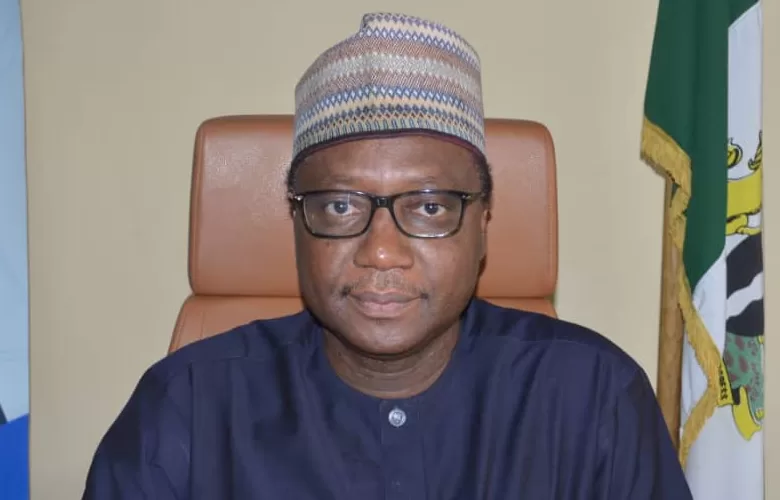
The Revenue Mobilisation Allocation and Fiscal Commission (RMAFC) has hinted at plans to review and increase the salaries of political office holders in Nigeria, describing their current earnings as “inadequate, unrealistic, and outdated” in light of mounting economic responsibilities and inflationary pressures.
Speaking at a press briefing in Abuja on Monday, the Chairman of the Commission, Mohammed Shehu, disclosed that the monthly salary of President Bola Tinubu stands at ₦1.5 million, while ministers earn less than ₦1 million — rates that have remained unchanged since 2008.
“You are paying the President of the Federal Republic of Nigeria ₦1.5 million a month, with a population of over 200 million people. Everybody believes that it is a joke,” Shehu stated.
He further questioned the imbalance in public sector pay, comparing presidential earnings with those of heads of agencies.
“You cannot pay a minister less than ₦1 million per month since 2008 and expect him to put in his best without necessarily being involved in some other things.
You pay either a CBN governor or the DG ten times more than you pay the President. That is just not right. Or you pay him [the head of an agency] twenty times higher than the Attorney-General of the Federation. That is absolutely not right,” he said.
In swift reaction, the Nigeria Labour Congress (NLC) strongly opposed the proposal, arguing that it ignores the country’s worsening inequality and the hidden benefits that significantly inflate the take-home pay of political office holders.
A top official of the NLC, who spoke to The PUNCH on condition of anonymity, said:
“The President’s salary may be about ₦1.5 million a month, but when allowances are added, the total package can exceed ₦100 million.
Allowances for medical care, housing, digital services, internet access, security, travel, and even COVID-related expenses are all buried in the system.
If the government can publish the president’s salary, then it should also publish these allowances, because that is where the true burden lies.”
The union warned that hidden perks, foreign trips, and overseas medical expenses contribute to the ballooning cost of governance, while workers and average Nigerians continue to suffer amid harsh economic realities.
“This inequality has destroyed the middle class and pushed millions into poverty, leaving citizens frustrated and disillusioned,” the official added.
“Good leadership requires sensitivity to the people’s plight. If politicians continue to prioritise themselves over the nation, this country risks imploding. And if that happens, even the elite will not have a country to fall back on,” the union warned.
Defending the Commission’s move, Shehu clarified that the RMAFC is not responsible for setting the national minimum wage, but is constitutionally empowered to determine the earnings of political, judicial, and legislative office holders.
“We are strictly restricted to political office holders, governors, senators, legislators, ministers, DGs, and other people,” he stated.
Despite public pushback, Shehu called for support from the media and citizens in helping the Commission ensure fair and realistic remuneration for government officials.
“It’s about time that people like you and others should support the Commission to come up with reasonable living salaries for ministers, DGs, and the President,” he said.
Alongside salary adjustments, Shehu announced the commencement of a long-overdue review of Nigeria’s vertical revenue-sharing formula, which determines how revenues are distributed among the federal, state, and local governments.
The current structure, in place since 1992, allocates 52.68% to the Federal Government, 26.72% to states, and 20.60% to local governments, with an additional 4.18% set aside for special funds — including the Federal Capital Territory (1%), ecological fund (1%), natural resources development fund (1.68%), and stabilisation (0.5%).
“In line with this constitutional responsibility and in response to the evolving socio-economic, political and fiscal realities of our nation, the Commission has resolved to initiate the process of reviewing the revenue allocation formula to reflect emerging socio-economic realities,” Shehu explained.
He said recent constitutional amendments have expanded the fiscal responsibilities of state governments, requiring a re-evaluation of the federal structure.
“The situation has made it essential to re-evaluate the structure of fiscal federalism in order to foster economic growth in individual states, enabling them to become independent from the central government and ensuring equity, responsiveness, and sustainability.”
Shehu recalled that a proposed review presented in 2022 under former Chairman Elias Mbam — recommending 45.17% for the Federal Government, 29.79% for states, and 21.04% for local governments — was never implemented by the Buhari administration.
Historical records show similar failed efforts in 2013, when the Commission held a two-week retreat at Tinapa Business Resort, Calabar, and adopted a draft formula that was supposed to be submitted to President Goodluck Jonathan. However, Jonathan did not table it before the National Assembly, as constitutionally required. The same inaction was observed during Buhari’s tenure.
Despite repeated setbacks, Shehu said the current RMAFC remains committed:
“This review will be inclusive, data-driven, and transparent. It will involve consultations with the Presidency, National Assembly, state governors, ALGON, the judiciary, civil society organisations, the private sector, and development partners.”
READ ALSO: President Tinubu Reduces Kidney Dialysis Cost from ₦50,000 to ₦12,000 Nationwide
He also announced that, for the first time, the Commission now enjoys financial autonomy following the signing of a new Act into law in April 2025.
Renowned Professor of Finance and Capital Market, Professor Uche Uwaleke, speaking at the event, emphasized that any increase in allocations to states must be ring-fenced for capital projects.
“Nothing stops us from also saying the extra money we want to push to states now, we can also ring-fence those funds so that when they go to those states, we are sure of what the funds are going into.
Now that states take care of electricity, for example, they also have the mandate to go into electricity. That’s infrastructure. We can say, and railways, we can say the extra money should be for infrastructure funds,” he said.
He also proposed a revision of the horizontal allocation formula — the system used to distribute revenue among states and LGAs — to reflect social development efforts rather than just population.
“Wouldn’t it make sense to reduce population from 30 per cent and shift it to social development effort? That speaks to efforts of sub-nationals in the area of health and education. That to me should be what should be driving the allocation, not just population.”
Uwaleke urged benchmarking against international federal systems:
“It is also important to benchmark what happens in similar federating units. We should look at Canada, Brazil, and India. What is the situation there? Let’s learn from international best practices.”
Amid these policy discussions, Nigeria continues to grapple with economic hardship. The National Bureau of Statistics (NBS) reported that the country’s headline inflation rate fell for the fourth straight month in July 2025, easing to 21.88% from 22.22% in June. However, food inflation remained a concern at 22.74% year-on-year, though down from 39.53% in July 2024.