
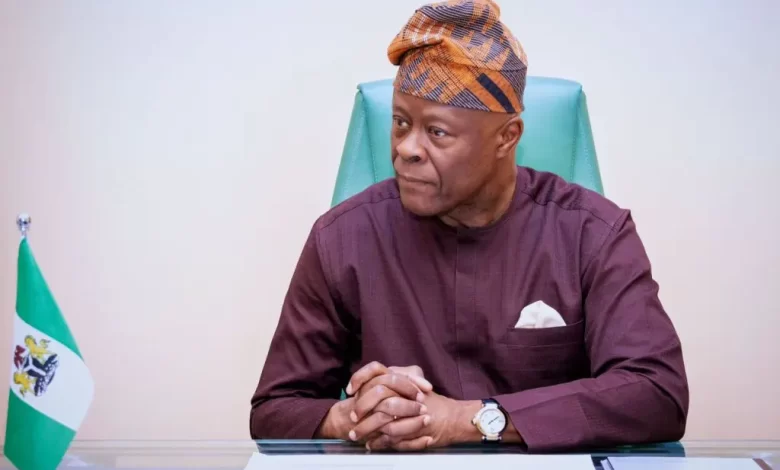
Contrary to speculations that the five per cent fuel tax introduced in the newly signed Tax Administration Act 2025 would take effect from January 1, 2026, the Minister of Finance and Coordinating Minister of the Economy, Mr. Wale Edun, clarified that the Federal Government has no immediate plans to implement the surcharge.
This was disclosed at a news conference in Abuja on Tuesday.
He said that the surcharge was a long-standing provision first introduced in 2007 under the Federal Road Maintenance Agency (FERMA) Act, and not a new tax measure created by President Bola Tinubu administration.
According to him, the surcharge’s inclusion in the 2025 Act is part of efforts to consolidate and harmonise existing laws for clarity and ease of compliance.
“It is important to make this distinction, the inclusion of the surcharge in the 2025 Nigeria Tax Administration Act does not mean an automatic introduction of new tax. It doesn’t mean fresh taxation automatically,” the minister said.
Edun said that the new law would not take effect until January 1, 2026, and even then, any implementation of the surcharge would require a formal commencement order by the minister of finance, published in an official gazette.
“There is a whole formal process involved, and as of today, no order has been issued, none is being prepared and there is no plan. There is no immediate plan to implement any surcharge,” he said.
According to him, government’s broader tax reform effort is a long-overdue overhaul of the country’s fragmented tax system.
Edun said that the Tax Administration Act is one of four legislative instruments passed to improve transparency, simplify compliance for individuals and businesses, and modernise revenue collection.
He said that the other laws include the Revenue Service Bill, the Joint Revenue Board Bill, and the overarching Tax Reform Bill.
“This is a transformational legal document.
Edun said that the process of preparing the reforms followed years of consultation, technical work and collaboration.
The minister said that moving from legislation to implementation would also involve significant preparation, including institutional realignment, capacity building, and public sensitisation.
Edun said that amid heightened public scrutiny and economic pressure on households, the present administration remains committed to macroeconomic stability and private-sector-led growth.
He said that the goal of the tax reforms was not to impose new burdens on Nigerians, but to create a more transparent and effective tax system that curbs leakages, boosts efficiency, and fosters investor confidence.
“This government is fully aware of the economic pressures of the time and will not take decisions that will make things even more burdensome.
“Our priority is to strengthen tax governance, block revenue leakages, and improve efficiency rather than just levy new taxes, charges, and costs,” Edun said.
The minister said that the ongoing macroeconomic reforms has begun to yield results, improving investor sentiment and recent affirmations from development partners and international rating agencies.
READ ALSO: Bayo Ojulari, NNPCL Boss faces Scrutiny over Secret Salary Increase, Extravagant Spending
He said that there would be the need for proper communication and implementation of the new tax framework in the months ahead.
“As you know with all policies, once the policy is passed into law, the next step is implementation.
“There will be publicity, sensitisation, education and information on the new tax law,” Edun said.
Also confirming this the Chairman of the Presidential Committee on Fiscal Policy and Tax Reforms, Taiwo Oyedele, speaking on Channels Television’s The Morning Brief on Tuesday, said the decision was made to include the five per cent fuel surcharge in the new law and to set a commencement date in the future, based on an order to be gazetted by the minister.
“So nobody will just spontaneously introduce the tax and create problems for the system,” Oyedele said.
Since the announcement, many Nigerians, as well as labour unions, have raised objections, describing it as ‘one tax too many. They are particularly opposed to such a tax at a time the nation is grappling with an inflation rate of 21.88 per cent.
On Monday, the Trade Union Congress (TUC) issued a 14-day ultimatum for the government to withdraw the tax or risk a national strike.
Oyedele said before the tax laws were enacted, there was an attempt by the Federal Road Maintenance Agency (FERMA) to collect the five per cent fuel tax.
According to him, “I can tell you that before this tax laws were enacted and shortly after it was signed, there was already an attempt by FERMA to even collect the tax and we had to say to them, ‘You can’t collect it because the new law says you’re not the one to collect and commencement will not happen till the minister says so.’ There is nothing that says this tax will start 1st January 2026. People need to get that right.”
Oyedele, who previously stated that the five per cent fuel tax is not new and was introduced in 2007, said it was wrong for the TUC to threaten to go on strike if the decision was not reversed.
He said, “The surcharge was introduced by a previous government and not the administration of President Bola Tinubu.
“TUC, which is planning to go on strike to say it should be removed, I don’t know what they want the government to remove, because it hasn’t been imposed, and there is no regulation that says it would be imposed from January.
“The TUC should have complained and protested when this was introduced in 2007.”
The new tax is one of the current administration’s series of reforms aimed at boosting tax revenue to finance development.
The government says this new tax will mobilise funds for critical infrastructure, a sector deemed essential for national development. The Nigeria Tax Administration Act already provides for such a tax. According to the plan, it would be “calculated based on the retail price of fuel and diesel” and applied to all taxable fossil fuels supplied or produced in Nigeria, to be collected at the point of supply or sale. However, Kerosene, liquefied petroleum gas (LPG), compressed natural gas (CNG), and renewable energy sources are exempted.