
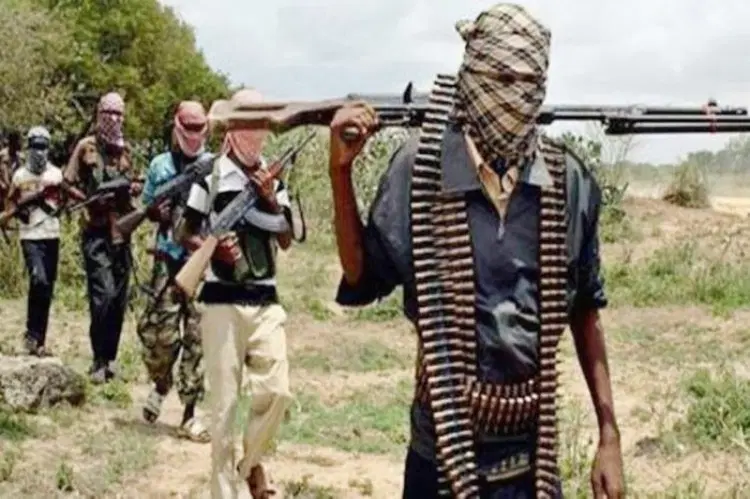
The Federal Government has officially classified kidnappers and violent armed groups operating across the country as terrorists.
The development signaled a major escalation in Nigeria’s response to abductions, attacks on farmers and persistent community violence.
The Minister of Information and National Orientation, Mohammed Idris, announced the development during the Federal Government’s end-of-year press briefing in Abuja on Monday.
Idris said the new designation marks a clear departure from treating mass kidnappings and rural attacks as conventional criminal acts, noting that such groups will now be confronted using full counterterrorism measures.
“Henceforth, any armed group or individual that kidnaps our children, attacks our farmers, and terrorises our communities is officially classified and will be dealt with as a terrorist,” the minister said.
According to him, the policy ends years of what he described as unclear labels for violent groups terrorising communities across the country.
“Now, the era of ambiguous nomenclature is over. If you terrorise our people, whether you are a group or you are an individual, you are a terrorist and will be classified as such. There is no name hiding under this again,” Idris added.
In a bid to secure vulnerable rural areas, Idris also announced the deployment of trained and equipped forest guards, saying that these personnel will combine surveillance, local intelligence, and rapid-response capabilities to secure forests and remote locations often used as hideouts by criminal groups.
READ ALSO: Senate Declares Kidnapping Terrorism, Pushes Death Penalty for offenders
He explained that the new approach would enhance intelligence sharing and improve operational coordination among security agencies, enabling quicker and more decisive action against perpetrators of violence.
By classifying kidnappers as terrorists, the government is signalling zero tolerance for abductions and rural violence, while expanding the powers of security forces.
The forest guard initiative is expected to disrupt criminal supply routes, dismantle camps, and provide reassurance to farming communities affected by insecurity.
He noted the arrest of the ISWAP head residing in Nigeria, described as one of the most wanted terrorists on the African continent, who had a substantial bounty placed on him by the United States.
“The most internationally wanted criminals, the ISWAP head residing in Nigeria, has been captured through the coordination of all the security agencies and those also in the intelligence community.
“Don’t forget that Abu Barra was captured a few months ago, and he was also presented to the public by the National Security Advisor and other security chiefs.
“This is one of the most wanted terrorists on the African continent, and he was captured through the coordination of our security forces.
“Remember also, this was someone who had a large sum of money put on his head by even the Americans to capture him and bring him to justice.
“As we speak today, this gentleman, together with his chief of staff, is undergoing and having their day in court, and he is going to get justice that befits them,” he said.
The minister also spoke on Nigeria’s recent diplomatic tensions with the United States following comments by US President Donald Trump, who had threatened military intervention over allegations of killings of Christians in Nigeria.
Idris said the disagreement had been largely resolved through diplomatic engagement.
“The recent diplomatic spat with the United States has been largely resolved through a firm, respectful engagement culminating in a strengthened partnership between America and Nigeria,” he said.
Trump had, in October and November, claimed that Nigerian Christians faced an “existential threat” and described the situation as “genocide” amid the country’s multiple security crises.
While the remarks drew mixed reactions, with some welcoming international attention and others warning against inflaming religious tensions, Nigeria remains on Washington’s list of countries of “particular concern” over alleged religious freedom violations.
Last week, Nigeria was also among several countries affected by new visa and immigration restrictions announced by the Trump administration.