
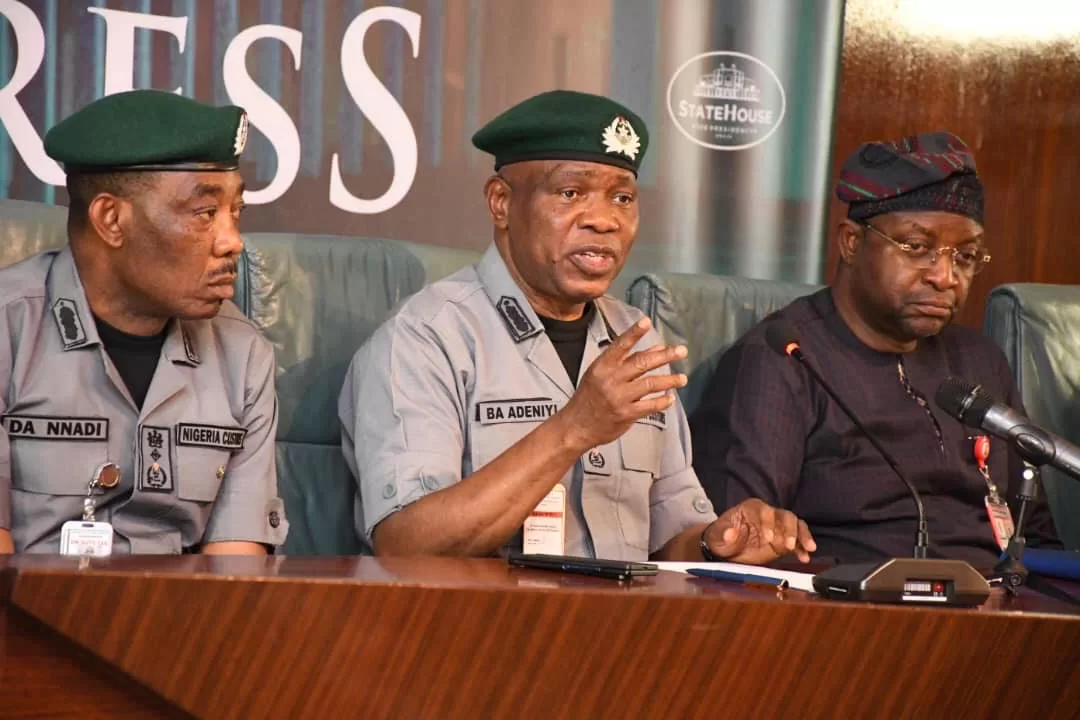
Nigeria’s removal from the Financial Action Task Force (FATF) grey list is the result of two years of coordinated reforms, strengthened inter-agency collaboration, and significant investments in technology, Comptroller-General of the Nigeria Customs Service (NCS), Adewale Adeniyi, said at a weekend briefing in Abuja.
The briefing was held ahead of the Customs PACT (C-PACT) Conference scheduled for November 17–19, 2025, with the theme “Breaking Barriers, Building Bridges.”
Adeniyi described the delisting as a “major national milestone,” noting that Nigeria is now firmly positioned to prevent a relapse into the grey list following its greylisting in February 2023 for strategic deficiencies in anti-money laundering and counter-terrorist financing (AML/CFT) frameworks. The country’s exit came after the successful completion of a 19-point, multi-sector reform plan aimed at addressing vulnerabilities in the financial and trade ecosystem.
“The grey list was an infamous list on which Nigeria was harnessed. There were a number of issues that led us into it,” Adeniyi said. “But today, through technology and coordination, we have made significant strides to avoid a return to that list.”
He explained that Nigeria’s journey out of the grey list required deeper reforms across customs, financial intelligence, law enforcement, and regulatory institutions. Central to these reforms, he noted, was a renewed commitment to eliminating loopholes exploited for illicit finance, smuggling, terrorism financing, and trade-based money laundering.
Adeniyi underscored technology deployment as one of the most transformative tools used to strengthen compliance and surveillance. One major step, he said, was the introduction of the electronic currency declaration form, which replaces the manual system previously used at airports and land borders.
“One of the things we have done with technology is to deploy the electronic currency declaration form. Now, you have a barcode to scan, and the form is downloaded and sent electronically to the NFIU and EFCC. This has streamlined our processes and enhanced transparency,” he explained.
According to him, the automation closes avenues for human interference, reduces delays, and provides real-time intelligence to relevant agencies monitoring suspicious transactions and currency movements.
In addition, Adeniyi highlighted the deployment of non-intrusive scanners at critical ports of entry, including Nnamdi Azikiwe International Airport in Abuja and Murtala Mohammed International Airport in Lagos. The scanners are being positioned as key assets in the fight against illicit trade, narcotics smuggling, and concealment techniques used to undermine border security.
“Technology helps a lot,” he said, noting that modern scanning systems have significantly reduced physical inspection time while improving detection accuracy. He described the equipment rollout as part of a broader modernization effort aimed at aligning Nigeria’s ports with global best practices.
Beyond technology, Adeniyi stressed that inter-agency coordination played an equally vital role in securing Nigeria’s delisting. He said the Customs Service worked closely with the Nigerian Financial Intelligence Unit (NFIU), Economic and Financial Crimes Commission (EFCC), Central Bank of Nigeria (CBN), security agencies, and international partners to ensure unified implementation of the FATF action plan.
READ ALSO: Naira Marley reaveled his side of the story on Mohbad’s death
He described past institutional fragmentation as a major weakness that contributed to Nigeria’s greylisting, arguing that the 2023–2025 reform cycle demonstrated the success of “bringing all agencies under one roof to avoid working at cross purposes.”
Adeniyi added that the C-PACT Conference would further deepen collaboration among stakeholders in customs modernization, trade facilitation, border security, and compliance frameworks. The conference, he said, will provide a platform to consolidate the achievements of the delisting and explore next-phase reforms.
With Nigeria now off the grey list, he emphasised the need for continuous vigilance, improved data sharing, updated regulations, and sustained investment in technology to maintain global confidence in Nigeria’s financial and trade systems.
“This is not the end of the journey,” Adeniyi said. “It is the beginning of a stronger phase for Nigeria’s integrity, credibility, and global competitiveness.”