
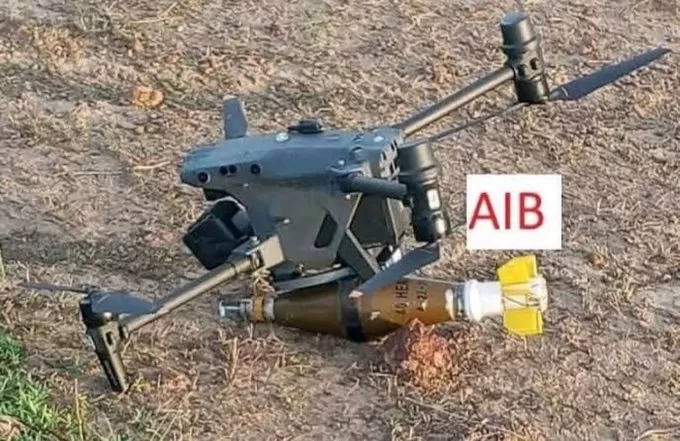
In a worrying escalation of tactics, Boko Haram insurgents on Saturday reportedly deployed armed drones and improvised explosive devices (IEDs) in a coordinated assault against Nigerian military positions in Borno State, security sources have confirmed.
The incident marks the first known use of armed drones by the terrorist group in Nigeria’s decade-long insurgency, raising fresh concerns over the growing sophistication of militant operations in the Lake Chad region.
According to military sources, the insurgents launched a simultaneous attack targeting multiple troop locations in the Gwoza–Bama axis, deploying explosive-laden drones to support their ground assault. Troops reportedly engaged the attackers in a fierce firefight that lasted several hours.
Security operatives said the armed drones were used to drop small explosives near defensive perimeters, while fighters on the ground attempted to breach the military base using vehicle-borne IEDs. However, soldiers repelled the assault after calling in air support from the Nigerian Air Force, neutralizing several insurgents and destroying two armed drones during the counter-operation.
A senior military officer, who spoke under anonymity due to operational sensitivity, said, “This is a significant tactical shift by Boko Haram. Their ability to modify commercial drones for armed use shows an alarming level of technical adaptation. But our troops stood firm and successfully thwarted the attack.”
READ ALSO: Tinubu Departs Abuja for Aqaba Security Summit in Rome
Preliminary reports indicate that at least six insurgents were killed, while several others fled with injuries. There were also unconfirmed reports of minor injuries among troops, but no official casualty figure has been released.
Residents in nearby communities said they heard loud explosions and gunfire late into the night, prompting many to flee into surrounding bushes. “We saw strange lights in the sky before the explosions began. Later, the soldiers told us drones were used in the attack,” a displaced resident recounted.
Military analysts say the incident underscores the need for enhanced counter-drone capabilities and electronic warfare systems to combat emerging threats from non-state actors. The development also suggests that Boko Haram may be receiving technical assistance or materials from transnational terror networks operating across Africa’s Sahel region.
The Defence Headquarters is yet to issue an official statement, but security experts warn that the introduction of drone warfare by insurgents could complicate ongoing counterterrorism efforts in the North-East.
Boko Haram and its splinter faction, the Islamic State West Africa Province (ISWAP), have waged a brutal insurgency since 2009, leading to over 35,000 deaths and the displacement of millions. While sustained military offensives have weakened their territorial control, Saturday’s attack suggests the militants remain capable of evolving their tactics.
Authorities have since reinforced the affected military bases and launched surveillance operations to trace the source of the armed drones and explosives used in the assault.