
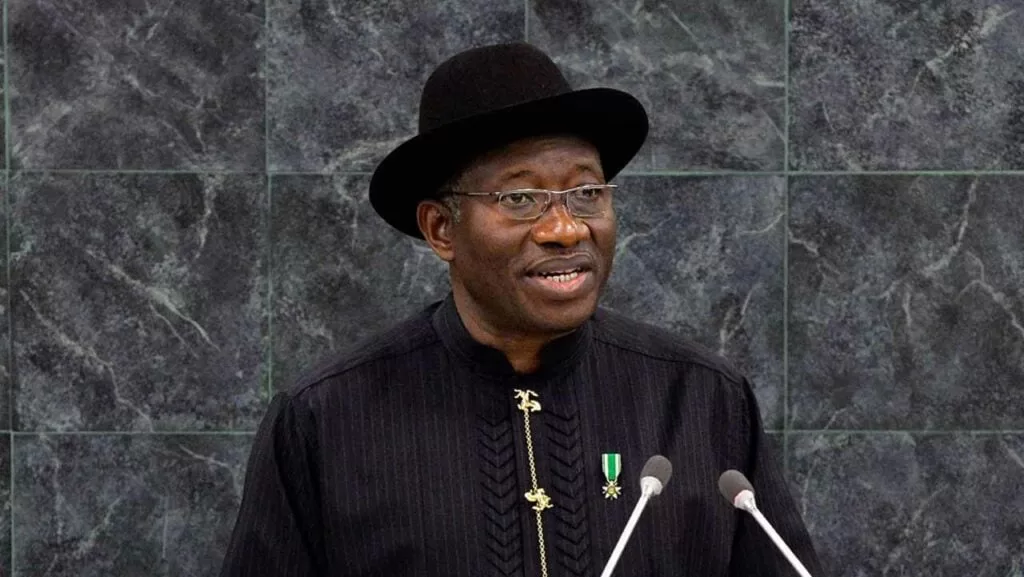
Former President Goodluck Jonathan has warned that Africa’s democratic future is under threat unless young people are deliberately brought into leadership and decision-making positions, saying the continent cannot sustain democracy while excluding its most vibrant population.
Jonathan spoke on Thursday at the Murtala Muhammed International Lecture and Leadership Conference themed “Has Africa Come of Age?”, organised by the Murtala Muhammed Foundation in Abuja, where he urged African countries to lower age barriers and strengthen institutions that allow youth participation in governance.
Describing Africa as a predominantly young continent, Jonathan said growing frustration among youths should not be mistaken for a rejection of democracy.
He anchored his argument on the legacy of the late Head of State, General Murtala Muhammed, who assumed office at the age of 38 and governed with what he described as clarity of purpose and selfless national vision.
According to Jonathan, Murtala’s brief but impactful leadership showed that age is not a barrier to effective governance when leaders are driven by patriotism and discipline.
“General Murtala Muhammed assumed office as Head of State at a very young age. Despite a tenure of only 200 days, his achievements were profound because he was driven by a clear, unyielding vision for a greater Nigeria,” he said.
Jonathan criticised long-standing political structures that sideline younger Nigerians, recalling that when he first contested for office, age limits shut many young people out of leadership.
He reinforced support for the Not Too Young To Run movement, arguing that leadership in the modern era requires physical strength, mental alertness and stamina often found among younger leaders.
“If we are looking for people who can run nations in Africa, we should look at the age within our day and age. That is how you can be vibrant, physically strong and mentally sound,” Jonathan said.
Beyond youth inclusion, the former president reflected on Nigeria’s democratic journey, stressing that leadership in a democracy is tested not by the extent of power but by how that power is exercised.
He recalled the pressures his administration faced, including security challenges, economic difficulties and political divisions, warning that such moments often tempt leaders to compromise democratic principles.
READ ALSO: I was never Tinubu’s friend, we are different people, parallel lines that will never meet – El-Rufai
“In such moments, leaders are tempted to sacrifice democracy for convenience. Yet democracy must be strengthened and made to deliver, even at personal cost to leaders,” he said.
Jonathan further noted that Africa’s governance challenge is not the absence of elections but the lack of a durable democratic culture rooted in credible polls, respect for term limits, judicial independence and press freedom.
He said Nigeria carries a special responsibility in this regard, as its democratic successes or failures often reverberate across the continent.
“When democracy succeeds in Nigeria, it strengthens democracy across Africa. When it falters, the consequences are far-reaching,” he said.
He also criticised what he described as weak discipline among some elected officials, noting that leaders who spend excessive time away from their states undermine governance and security.
According to him, discipline and presence were key factors that enabled young military leaders of earlier generations to govern effectively.
As the lecture marked 50 years since Murtala Muhammed’s assassination, Jonathan said the commemoration should serve as guidance for today’s leaders rather than mere nostalgia.
He urged young Africans to see leadership as service and older leaders to embrace stewardship over entitlement.
Also speaking at the event, former Vice-President Yemi Osinbajo revisited Murtala Muhammed’s famous 1976 declaration that “Africa has come of age,” describing it as a bold statement of self-determination and resistance to neo-colonialism.
Osinbajo said the declaration was not about age in years but about responsibility, agency and confidence of purpose.
He said, coming of age is not a moment; it is a process, adding that Africa’s story should not be framed by stereotypes or a single narrative of delay.
Highlighting continental progress, Osinbajo pointed to the African Continental Free Trade Area as evidence of Africa’s growing economic agency, noting that real goods are already moving across borders and creating jobs.
He also said Africa is increasingly positioning itself as a key player in global innovation, climate action and clean energy.
Returning to the central question of the lecture, Osinbajo said Africa has come of age “not because the journey is complete, but because the direction is clear,” urging a new generation of Africans to rise to the challenge first articulated by Murtala Muhammed.
“The age of asking whether Africa will rise is over. The age of engaging with Africa as a co-author of the global future has come,” he said.