


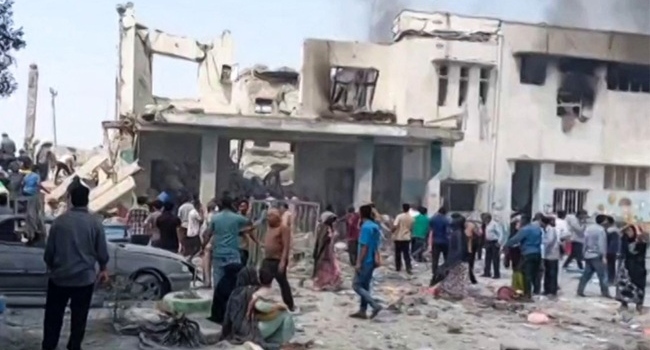
The deadly bombing of an Iranian school spurred “visceral horror”, the UN rights chief said Friday, urging Washington to conclude its probe and demanding justice “for the terrible harm done”.
The Iran’s foreign minister on Friday said the deadly bombing of an Iranian school on the first day of the Middle East war was a “calculated” assault by the United States.
In a video address to the United Nations Human Rights Council, Abbas Araghchi slammed the “calculated, phased assault” on an elementary school “in the city of Minab, south of Iran, where more than 175 students and teachers were slaughtered in cold blood”.
The attack happened on February 28, the day the United States and Israel launched the war with attacks across Iran, with Tehran in turn striking targets in Israel and Gulf nations.
A US Tomahawk cruise missile hit the school due to a targeting mistake, according to the preliminary findings of a US military investigation reported by The New York Times.
The Times said the US military was bombing an adjacent Iranian base of which the school building was formerly a part and target coordinates were set using outdated data.
President Donald Trump intially suggested that Iran itself may have been responsible — despite Iran not having Tomahawk missiles.
Speaking during an urgent council debate focused on the February 28 strike, Araghchi stressed that “at a time when the American-Israeli aggressors, in their own assertions, possess the most advanced technologies, and the highest-precision military and data systems, no one can believe that the attack on the school was anything other than deliberate and intentional”.
The strike, he said, “was a war crime and a crime against humanity, one that demands unequivocal condemnation by all and unambiguous accountability for the culprits”.
“This atrocity cannot be justified, cannot be concealed, and must not be met with silence and indifference,” the minister said.
The attack, he insisted, “was not a mere ‘incident’ nor a ‘miscalculation’.”
“The United States’ contradictory remarks aimed at justifying their crime could not, in any manner, elude their responsibility,” he said.
Speaking at the start of an urgent debate in the UN Human Rights Council focused on the February 28 strike on an Iranian elementary school in Minab on the first day of the Middle East war, Volker Turk said that “whatever differences countries have, we can all agree they will not be solved by killing schoolchildren”.
The bombing “evoked a visceral horror”, Turk told the United Nations’ top rights body.
“The images of bombed-out classrooms and grieving parents showed clearly who pays the highest price for war: civilians with no power in the decisions that led to conflict,” he said.
READ ALSO: We’ve killed Iran’s navy chief overseeing Strait of Hormuz blockade — Israel
“In this case, a reported 168 pupils, teachers, school staff, and their loved ones.”
The UN rights chief stressed that “the onus is on those who carried out the attack to investigate it promptly, impartially, transparently and thoroughly”.
“Senior US officials have said the strike is under investigation,” he said, calling “for that process to be concluded as soon as possible, and for its findings to be made public”.
“There must be justice for the terrible harm done.”
Friday’s discussion, at the request of Iran, China and Cuba, marked the second urgent debate before the rights council this week, focused on the war in the Middle East.
On Wednesday, a debate requested by Bahrain on behalf of the Gulf Cooperation Council and Jordan, considered Iran’s strikes on countries across the Gulf region and their impact on civilians.
Following that debate, the 47-member council approved by consensus a resolution condemning Iran’s “egregious attacks” on its Gulf neighbours, calling for swift “reparation” to all victims of its strikes.
The council was not asked to consider a draft resolution during Friday’s debate, which was scheduled to last around two hours.

