
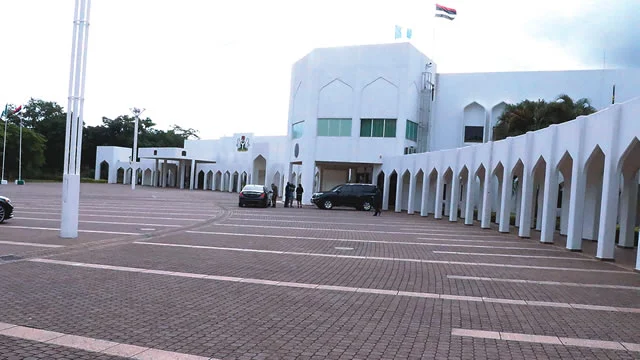
The Aso Presidential Villa in Abuja is on course to sever ties with the national grid by March 2026, as work on its solar power initiative reaches the final stage.
State House Permanent Secretary, Temitope Fashedemi, disclosed this on Wednesday while presenting the 2026 budget proposal to the Senate Committee on Special Duties at the National Assembly.
According to details later shared with journalists by the Presidency, Fashedemi explained that installation of the Villa’s solar mini-grid was concluded late in 2025 and has been undergoing technical trials since December.
He expressed confidence that a full transition to the new power system would be achieved within the first quarter of the year, noting that the shift is expected to significantly reduce government spending on electricity.
To demonstrate the project’s effectiveness, the Permanent Secretary cited the State House Medical Centre, which switched to solar power in May 2025. Since then, he said, the facility has operated almost entirely off-grid, without relying on generators and drawing only minimal supply from the Abuja Electricity Distribution Company (AEDC).
He added that the centre has depended largely on solar energy supported by battery storage, describing the outcome as proof that the broader Aso Villa project is viable.
READ ALSO: Senate Moves for Electricity Subsidy Removal to Bolster 2026 Fiscal Outlook
The Federal Government had earmarked N10 billion in the 2025 budget for the “Solarisation of the Villa with Solar Mini Grid,” a move that triggered debate among Nigerians. Critics argued that installing solar panels at the seat of power suggested a lack of confidence in efforts to stabilise the country’s electricity supply.
The 2026 Appropriation Bill proposes an additional N7 billion to complete the initiative.
However, government officials have defended the decision. Director-General of the Energy Commission of Nigeria, Mustapha Abdullahi, previously argued that maintaining the Villa on conventional power was financially unsustainable, citing an estimated annual electricity bill of N47 billion. Presidential spokesman Bayo Onanuga also pointed to the White House’s adoption of renewable energy as precedent.
Before the solar rollout, the State House had faced mounting electricity debts. In February 2024, AEDC named the Villa among major government debtors, placing its outstanding bill at N923.87 million. Following reconciliation, the amount was reviewed down to N342.35 million, which President Bola Tinubu subsequently directed to be paid.
Fashedemi further revealed that tests conducted during the solar project uncovered cases of alleged overbilling by AEDC, including charges for electricity not supplied. He said discussions were ongoing to reconcile what he described as legacy liabilities.
With the anticipated cutover, the Aso Villa’s ageing generators—installed when the complex was built—may soon become redundant. Fashedemi noted that although service providers had advised their replacement due to wear and tear, the success of the solar system could eliminate the need for such expenditure, aside from retaining a few units for emergency backup.
Meanwhile, Chairman of the Senate Committee, Senator Kaka Lawan (Borno Central), took issue with the N127 million budgeted for sport utility vehicles in the State House proposal, describing it as insufficient.
He argued that the allocation would not cover the cost of even a single bulletproof vehicle and warned against scenarios where visiting dignitaries would be conveyed in fairly used cars. The committee directed the Budget Office of the Federation to revisit the figure and make appropriate adjustments.
Lawan also praised the State House for promptly appearing before the committee to defend its estimates, saying the action set a commendable example for other ministries, departments and agencies.