
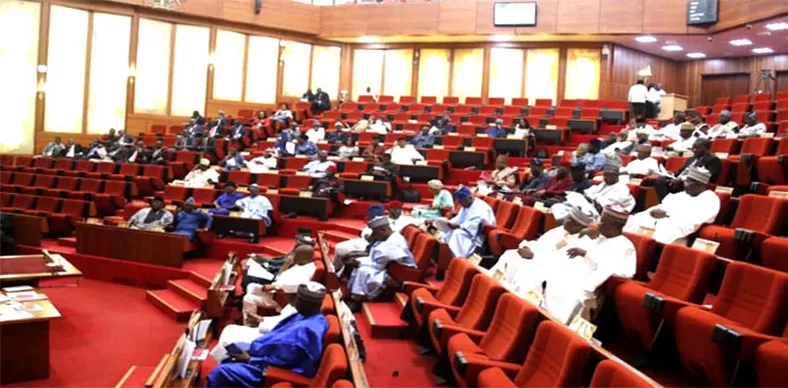
The Senate has approved a revised ₦43.561 trillion 2024 Appropriation Act and a reworked 2025 budget framework, following the passage of the Appropriation (Repeal and Re-enactment) Bills.
The bills were considered at the Committee of Supply and plenary, and subsequently passed by voice vote. Senators described the exercise as a significant step toward restoring fiscal discipline and ensuring budget clarity.
The development followed a letter from Senate President Godswill Akpabio to the National Assembly on December 19, 2025, conveying President Bola Ahmed Tinubu’s request to repeal and re-enact aspects of the 2024 and 2025 Appropriation Acts in line with constitutional and legislative procedures.
Senator Olamilekan Adeola, APC, Ogun West, who presented the bills, explained that the revisions reflected current fiscal realities, revenue constraints, and emerging national priorities. The 2024 budget was increased from the original ₦35.005 trillion to ₦43.561 trillion, covering statutory transfers, debt servicing, recurrent expenditure, and capital projects.
On the 2025 fiscal year, Adeola disclosed that the earlier N54.99tn Appropriation Act was repealed and replaced with a revised total expenditure of N48.316tn, noting that part of the capital expenditure was rolled over into the 2026 fiscal year due to funding constraints highlighted during the presidential budget presentation.
READ ALSO: Senate begins debate on ₦58.47tn 2026 budget
He revealed that extensive engagement between the committee and the economic management team informed the decision to repeal and re-enact the budgets, particularly to address concerns around revenue performance, debt exposure and effective implementation.
Highlighting key adjustments, Adeola said an additional N8.5tn was injected into the capital component of the 2024 budget to fund special interventions in response to security, humanitarian and economic emergencies facing the country.
He added that the revised framework was structured to balance responsiveness with fiscal responsibility, ensuring that debt-related spending does not erode legislative oversight or fiscal prudence.
For the 2025 budget, the committee observed that N6.674tn was removed from the capital allocation and deferred to the 2026 fiscal year to enhance budget effectiveness in anticipation of improved revenue inflows.
Adeola also warned against the continued practice of running multiple budget cycles concurrently, stressing that extending the lifespan of one budget while another is already in force undermines fiscal discipline, transparency and accountability.
Based on these findings, the committee recommended that the Senate approved the repeal and re-enactment of the 2024 Appropriation Act to authorise total expenditure of N43.5tn from the Consolidated Revenue Fund, alongside the revised N48.3tn framework for the 2025 fiscal year, and extend the implementation of the 2025 budget to March 31, 2026.
The Senate subsequently passed the bills for third reading after exhaustive debate.
Deputy Senate President, Senator Jibrin Barau, APC, Kano North, commended the committee for producing a high-quality report within a limited timeframe.
Senators Sani Musa, APC, Niger East, and Adetokunbo Abiru, APC, Lagos East, emphasized that the revised budgets captured critical infrastructure projects, including rail and road developments, and would improve coordination while safeguarding priority spending.
Chief Whip, Senator Tahir Monguno, APC, Borno North, described the passage as a welcome reform to prevent distortions caused by overlapping budgets.
Meanwhile, the House of Representatives also passed the revised N43.56tn 2024 budget and the N48.31tn 2025 budget after considering and adopting the report of its Committee on Appropriations.
The passage followed clause-by-clause consideration of the estimates at the Committee of Supply and their subsequent approval at plenary presided over by the Speaker, Rt. Hon. Tajudeen Abbas.
A breakdown of the revised 2024 budget shows that N1.74tn was earmarked for statutory transfers, N8.27tn for debt servicing, N11.26tn for recurrent (non-debt) expenditure, while N22.27tn is allocated to capital expenditure and development fund contributions for the fiscal year ending December 31, 2025.
For the revised 2025 budget, N3.64tn is provided for statutory transfers, N14.31tn for debt service, N13.58tn for recurrent (non-debt) expenditure, and N16.76tn for capital expenditure through development fund contributions.
Like the Senate version, the 2025 budget is expected to run until March 31, 2026.
President Tinubu, in his communication to the National Assembly, explained that the revisions were necessitated by the need to accommodate budgetary items previously omitted and to adjust capital implementation targets in line with Nigeria’s execution capacity and revenue realities.
He said the revised framework reflects a more realistic capital implementation benchmark of 30 per cent.
The president acknowledged persistent weaknesses in the implementation of the capital component of the 2024 budget, noting that these challenges significantly undermined infrastructure delivery and development projects nationwide.
According to him, extending the lifespan of the 2025 budget to March 31, 2026, would allow Ministries, Departments and Agencies adequate time to access and utilise the targeted 30 per cent capital releases.
Tinubu said the approach forms part of a broader fiscal reform agenda aimed at correcting structural flaws in Nigeria’s budgeting process, including the long-standing problem of overlapping budgets.
He stressed that ending the practice of running multiple budgets simultaneously would improve planning, enhance implementation, and strengthen transparency and accountability in public expenditure.
The president added that the revised budget framework is designed to deliver more credible budget performance, better coordination of government programmes and improved value for money for Nigerians.