
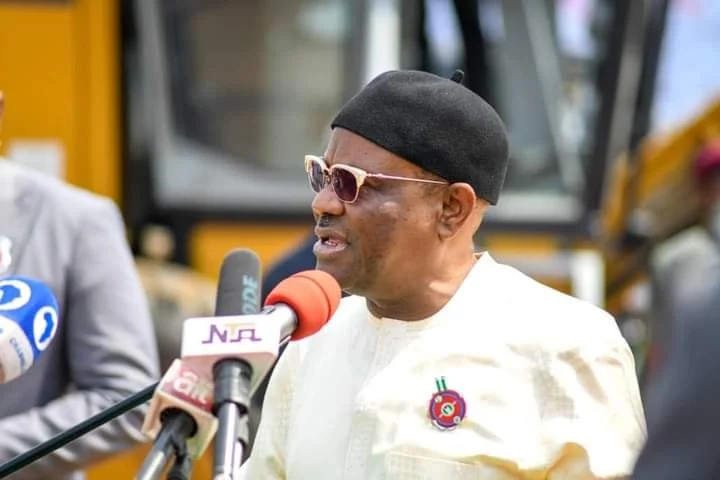
Here is a detailed month-by-month look at what Nyesom Wike as Minister of the Federal Capital Territory Administration (FCTA) was up to during 2025, based on public reporting.
January – February 2025
The year began with Wike preparing to implement the FCT’s 2025 agenda, though there are no major public headlines about new projects or controversies attributed directly to him in these months.
Behind the scenes, groundwork was presumably being laid for the capital projects that would later be unveiled in his 2025 budget presentation.
(Because media coverage was sparse in this period, many of Wike’s early-year activities may not yet be public.)
March 2025 — Crackdown on Unpaid Ground Rent; Land-Use Enforcement
On March 13, 2025, Wike, through a letter by the Director of Land Administration, revoked the right of occupancy for the land allocated to the national secretariat of the Peoples Democratic Party (PDP) Plot 243, Central Area (A00), Abuja. The revocation was justified by the party’s failure to pay ground rent for 20 years (from 2006 to 2025).
The decision was formally communicated to PDP, with the FCTA stating it would assume immediate possession of the property.
Wike defended the action, rejecting claims the revocation was politically motivated or aimed at stifling opposition. He argued the measure was part of broad enforcement of land-use and ground-rent regulations affecting not only PDP, but also institutions and individuals who defaulted on payments.
Overall, the FCTA announced the revocation of 4,794 land titles across Abuja for nonpayment of ground rents a decisive show of land-use enforcement.
Significance: This move sent a strong signal that FCT land-use regulations would be enforced strictly irrespective of political affiliation or status. For Wike, it underlined his willingness to treat even major political entities like PDP as defaulters.
April 2025
No widely reported major events directly involving Wike’s office in April likely a period of follow-through on the March revocations, preparation of budget proposals, and internal FCTA administrative work.
Given the extensive land-use enforcement in March, authorities may have been consolidating affected land, planning re-allocations, or dealing with administrative fallouts.
May 2025 — Budget Planning & Infrastructure Push
On May 22, 2025, Wike presented the FCT 2025 statutory budget before the joint Senate and House of Representatives Committees on FCT. He earmarked a portion of the proposed ₦1.78 trillion budget for capital projects, with ₦1.28 trillion (≈ 72.3%) allocated to capital (development) expenditure and ₦494.1 billion to recurrent expenditure.
Within that capital budget, Wike pledged to complete 14 ongoing road projects across Abuja covering both the city centre and satellite towns.
Among the roads and projects listed for completion or continuation:
Extension of the Inner Southern Expressway (ISEX) from Southern Parkway (S8/S9) to Ring Road II.
Full development of the FCT Highway 105 (Kuje Road) from Airport Expressway to the planned Outer Southern Expressway (OSEX) with a spur at Kyami District.
Construction/rehabilitation of several arterial and ancillary roads: e.g., Northern Parkway (Ring Road II to Ring Road III), Arterial Roads N20 & N1, dualisation of Kuje–Gwagwalada Road, access roads to bus terminals, upgrading of military-access roads (e.g., Ushafa War College/Army Checkpoint Road), and construction of roads in suburban areas such as Kwali, Guzape, Wuye, and Maitama II districts.
Significance: The budget and infrastructure push illustrate Wike’s strategic focus in 2025: using capital-intensive road construction and upgrading to deliver visible development in a way that could reshape traffic, connectivity, and general mobility in Abuja.
June – August 2025
During these months, the FCTA under Wike began ramping up execution of the road-construction commitments from the May budget. Several contracts, roadworks, and rehabilitations were reportedly underway (though media coverage remained partial).
According to public statements from Wike’s office, the emphasis was on delivering “essentials” rather than launching new white-elephant projects focusing on completion, not proliferation.
The FCTA expressed optimism that the roadworks would substantially reduce traffic congestion and improve access in satellite towns and city districts.
September – October 2025 Significant Infrastructure Developments & Public Communication
Towards the end of September 2025, plans were reportedly made for the formal flag-off of 12 new road projects in Abuja under Wike’s watch; some of them were to be complemented with solar-powered streetlights signalling a push for modern, sustainable urban infrastructure.
On November 27, 2025, Wike conducted an inspection tour of several major projects, including:
Emergency reconstruction of the Apo–Karshi Road (formerly awarded in 2011 but abandoned), now re-awarded to a new contractor.
Construction of the two main carriageways of the Outer Southern Expressway (OSEX) from Ring Road I junction to Ring Road II junction.
Construction of Collector Road CN2 (from Arterial Road N16 to Arterial Road N20) in Katampe District part of a planned network to improve intra-city connectivity.
During the inspection, Wike assured journalists that the projects would be completed by June 2026 and cited public appreciation at the sites portraying the developments as tangible benefits of the “Renewed Hope Agenda.”
Wike also announced that the FCTA would not likely start new major projects in 2026; instead, the focus will be on completing all projects started in 2025.
Significance: These moves suggest a pivot from planning to delivery an effort to convert budget promises into visible infrastructure. The re-awarding and reactivation of long-abandoned projects (like Apo–Karshi Road) may indicate lessons learned from past project delays.
Late November – December 2025 Consolidation, Oversight & Looking Ahead
On November 28, 2025, after inspecting key projects, Wike re-affirmed his commitment to ensure quality and timely completion of works such as OSEX, road carriageways, and the newly re-awarded Apo–Karshi Road project.
He warned against illegal constructions especially buildings on water channels vowing that the FCTA would enforce building regulations, even if that meant demolishing violators.
Wike declared that 2026 will be a year of consolidation: “We are not likely to start any new project. We want to ensure that all the projects we started this year are completed,” he said suggesting a shift from expansion to delivery and execution.
He also indicated that ongoing efforts in other sectors (education, health, urban planning) beyond roads would likely be advanced in 2026, tying them to the momentum of the FCT’s infrastructural transformation.
Significance: Wike appears to be setting the stage for 2026 as a “finishing year” — consolidating gains, closing out projects, and avoiding overextension. This strategy might aim to cement his legacy for the FCT and salvage political credibility after a turbulent end to his PDP membership.
Major Themes & Observations (2025 in Perspective)
✅ Enforcement & Accountability — Land-Use Crackdown
Wike’s revocation of thousands of land titles — including that of a major political party — underscores a no-nonsense approach to land administration. It signals to properties’ holders (individuals, institutions, political parties alike) that ground rent and compliance with land laws will be enforced, regardless of status.
🔧 Infrastructure-first Agenda — From Paper to Pavement
The 2025 budget and subsequent road-project flag-offs show that Wike prioritized core infrastructure roads, expressways, urban arteries as foundational to FCT’s development. By re-awarding long-stalled contracts and pushing for timely completion, Wike seems determined to make 2025 a year of delivery.
🛑 Shift in Political Allegiance & Identity
The expulsion from his longtime party (PDP) is arguably the most consequential political event of the year. It may reshape Wike’s path as a minister aligned with the ruling administration (rather than opposition), or perhaps preparing for future political realignment.
📆 Pragmatism Over Grandstanding
By November, Wike emphasized completion over new beginnings, signaling a more restrained, execution-oriented approach. Rather than chasing headline-grabbing new projects, he seems focused on fulfilling promises.
What This Means for the Future (Outlook into 2026)
If the commitment holds, many of the road and expressway projects begun under Wike in 2025 especially metropolitan arteries and satellite-town connectors should be completed by mid-2026, potentially transforming traffic flow and urban connectivity in Abuja.
The strict enforcement of land-use and ground-rent rules might lead to more reclamations, reallocations, or redevelopment of reclaimed plots which could reshape ownership patterns in Abuja’s prime areas.
Politically, Wike may attempt to reposition himself either as a technocratic minister detached from party politics, or as a kingmaker with an independent base. His expulsion from PDP could foretell deeper realignments or a new political identity.
The 2026 agenda is likely to focus on delivery finishing started projects, stabilizing infrastructure, and possibly expanding social services (health, education) within FCT, according to signals from the end-year inspection exercises.