


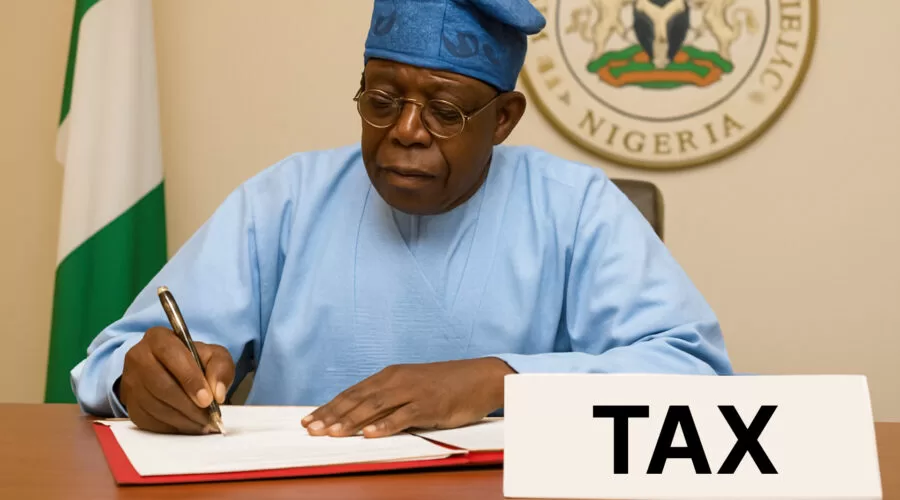
President Bola Ahmed Tinubu’s administration is pressing ahead with a sweeping overhaul of Nigeria’s tax system, following the signing of four landmark tax reform bills into law in June 2025.
The move, seen as one of the most ambitious fiscal policy shifts in recent Nigerian history, aims to harmonise, modernise, and broaden the country’s complex tax framework to improve revenue generation and reduce dependence on oil income.
The new legal framework — comprising the Nigeria Tax Act (NTA) 2025, the Nigeria Tax Administration Act (NTAA), the Nigeria Revenue Service (Establishment) Act (NRSA), and the Joint Revenue Board (Establishment) Act (JRBA) consolidates multiple tax laws into a single structure. It seeks to simplify compliance, enhance transparency, and strengthen coordination between federal and state tax agencies.
Under the new regime, large multinational corporations operating in Nigeria will face a minimum effective tax rate of 15 percent, in line with global tax standards. New controlled foreign company (CFC) rules and transfer pricing guidelines are designed to prevent profit shifting and tax evasion by multinational entities. The administration argues that such measures will ensure a fairer system in which global and local firms contribute proportionately to Nigeria’s economic growth.
The reforms also introduce relief for small and medium-sized enterprises (SMEs), exempting companies with an annual turnover below ₦100 million from corporate tax or applying significantly reduced rates. This provision aligns with Tinubu’s “Renewed Hope” agenda, which emphasises private-sector growth, job creation, and industrial expansion.
READ ALSO: FG to End Income Tax for Nigerians Earning Below ₦800,000 by 2026
However, the reforms have not been without controversy. Governors and legislators have expressed divergent views over aspects of the bills, particularly concerning revenue sharing and states’ fiscal autonomy. Critics fear that excessive centralisation of tax collection under the new Nigeria Revenue Service could weaken state capacity and delay remittances. Some lawmakers also worry that the measures could raise the cost of living if indirectly passed down to consumers through higher prices on goods and services.
Public sentiment remains cautious, with citizens expressing concern that the new taxes might deepen hardship amid inflation, fuel price hikes, and currency depreciation. These fears prompted the federal government to delay full implementation until January 2026, allowing more time for consultation and adjustment.
International observers, including the World Bank and PwC Nigeria, have welcomed the reforms as steps toward fiscal sustainability, provided they are implemented with fairness and efficiency. Analysts note that Nigeria’s tax-to-GDP ratio, hovering around 10 percent, remains one of the lowest globally. Tinubu’s reforms aim to raise it to at least 18 percent by 2028 a target viewed as critical for funding infrastructure, healthcare, and education.
Ultimately, the success of Tinubu’s tax bills will depend on how effectively the government balances revenue expansion with economic inclusion. As the new tax era approaches, the administration faces the challenge of restoring public trust proving that higher taxes can indeed translate into better governance, efficient services, and a stronger economy.

