


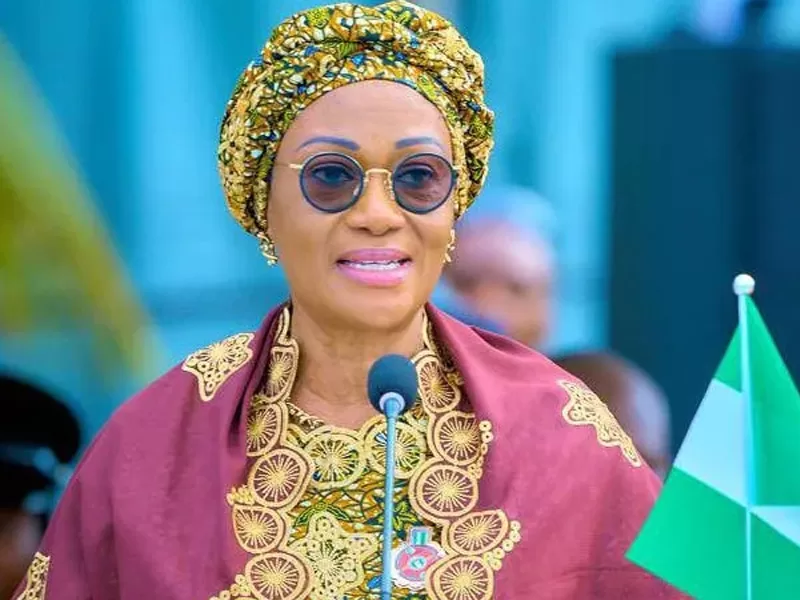
In a packed month of October, Nigeria’s First Lady, Oluremi Tinubu, emerged as a pivotal figure across multiple sectors education, health, digital transformation, and women’s economic empowerment.
Her schedule featured high-level international engagements, nationwide health messaging, and the inauguration of cutting-edge learning facilities.
With each initiative dovetailing into the broader “Renewed Hope” agenda of her husband’s administration, her activities underscore how the role of the First Lady is increasingly strategic, not merely ceremonial.
Top of the story
On October 1, Tinubu hosted the Russian chapter of the BRICS Women’s Business Alliance at the State House in Abuja, declaring Nigeria “fertile ground for global partnerships”.
In the first week of October, she marked the global Breast Cancer Awareness Month with a call to women to prioritise early detection and self-examination.
On October 7 she launched a nationwide vaccine campaign under her office, targeting measles and rubella and aiming to immunise over 100 million children.
On October 10 she celebrated the International Day of the Girl Child, emphasising the value and potential of female children across Nigeria.
Later in the month, on October 23, she inaugurated a digital learning centre in Yobe State under the Renewed Hope Initiative (RHI) Social Investment Programme, announcing a network of digital hubs across several states.
These headline moves form a coherent narrative: First Lady Tinubu leveraging her platform to accelerate Nigeria’s transition in health, education, global business linkages and digital transformation.
A blueprint for the month
1. International partnerships as an economic lever
The October 1 gathering of the BRICS Women’s Business Alliance a global network of women entrepreneurs and business executives placed Nigeria firmly in the spotlight as a continental gateway. Tinubu emphasised that while her office provides advocacy and facilitation, the statutory ministries hold budgets and responsibility.
In practical terms, the Alliance announced the donation of 1,000 labour and delivery kits to support maternal health in Nigeria, and plans for its regional office to be sited in the country, thereby reinforcing Nigeria’s role as a node in women-led business across the 1.3 billion-person market served by the AfCFTA.
For Tinubu, the event reinforced her advocacy for women entrepreneurs while positioning her foundation and initiatives (such as the RHI) as complementary to the formal machinery of government.
2. Health messaging that aligns with national imperatives
Early October marked two major interventions in health: First, a call during Breast Cancer Awareness Month for women to conduct self-exams and screening, emphasising “early detection saves lives”.
Then, on October 7, the launch of a large-scale immunisation campaign for measles and rubella aimed at over 100 million children underpinned the First Lady’s push into public health beyond traditional ceremonial support.
The combination of adult health focus (women’s cancers) and child health focus (vaccination) illustrates a layered strategy: targeting both ends of the demographic spectrum to strengthen the country’s long-term health base.
3. Education, digital access and bridging divides
On October 10 the International Day of the Girl Child provided the platform for Tinubu to highlight the struggles and promise of girls those walking miles to class, carrying water, or living in displacement and to call for societal support.
Later in the month she inaugurated a digital learning centre in Yobe State, announcing that nine other centres had been already established in states such as Abia, Edo, Delta, Katsina, Lagos, Nassarawa, Kano and Zamfara.
These announcements reflect two parallel moves: (a) addressing access to education for girls (and young people more broadly), and (b) ensuring that the system is ready for a digital economy. Tinubu noted that increasing access to digital skills would enhance participation in economic diversification through industrialisation and digitalisation.
Peoples Gazette Nigeria
4. Thematic coherence: Renewed Hope, transformation and empowerment
What unites these interventions under Tinubu’s watch is the alignment with the “Renewed Hope Initiative (RHI)” umbrella. The RHI is a Social Investment Programme tied to the presidency’s agenda of economic diversification, human capital development and digital readiness. For example, the digital centres were created under the RHI in partnership with the National Information Technology Development Agency (NITDA).
Furthermore, the health campaigns and global women’s business partnership frame Nigeria not only as a recipient of aid or intervention, but as a potential partner, investor, and front-line nation in Africa’s growth story. This allows the First Lady to move beyond mere philanthropy into policy-adjacent advocacy making her role one of facilitation and influence.
Spotlight: Key stories in detail
Hosting the BRICS Women’s Business Alliance
By convening the Russian chapter of this women’s business organisation, Tinubu did more than host a meeting she positioned Nigeria as a strategic bridge between Africa and global women-entrepreneur networks. The delegation was led by Anna Nesterova and included executives from Russia’s VET PHARM Group, United Migration Center, and Third Opinion AI.
In her address, Tinubu underscored that government ministries have the budgets for economic engagement; her role, within the First Lady’s office, is to advocate and encourage. This distinction matters: it shows an awareness of roles and boundaries within governance. She also spotlighted how her foundation’s work (such as the library project and sanitary kit distribution) complements formal state mechanisms.
Ministerial participation and cross-sector commentary suggested the gathering was more than symbolic: it can lead to frameworks for cooperation in areas like agriculture, food security, mining, energy and the digital economy all filtered through a gender-lens and anchored in women’s entrepreneurship.
Breast cancer awareness & immunisation campaign
On October 6 Tinubu issued a clarion call for women across Nigeria: “our health must remain a priority. Early detection saves lives.”
This messaging during Breast Cancer Awareness Month is tactical: it addresses an under-served dimension of women’s health in Nigeria, and raises the profile of preventive health behaviours.
Then on October 7, with the launch of the national immunisation drive for measles and rubella, the focus shifted to child health and building the country’s long-term wellness base. The target over 100 million children reflects scale and ambition.
The dual health interventions demonstrate a layered approach: empowering women to safeguard their own health, and targeting children’s health as part of the broader human capital investment.
Education and digital literacy across states
Inaugurating a digital learning centre in Yobe State on October 23, Tinubu announced that nine additional centres are already in place across other states. She noted that the RHI and NITDA had established and equipped fifteen ICT centres nationwide.
Peoples Gazette Nigeria
Tinubu stressed that access to digital skills is no longer optional but critical to livelihood, creativity, entrepreneurship and participation in the digital economy. The plan places digital literacy at the heart of the country’s transformation agenda.
This move also intersects with the October 10 celebration of girls: by increasing access to ICT resources and infrastructure, Tinubu’s office is promoting an inclusive model where girls and young women can engage in education and economic opportunity shifting from talk to tangible infrastructure.
What’s new in the First Lady role?
Traditionally, First Ladies in Nigeria have had roles in advocacy, philanthropy and patronage. But October’s flurry of activity under Tinubu signals a sharpening of purpose and alignment with national policy objectives. Several features stand out:
Strategic international engagement: Hosting global women’s business networks, she is turning the First Lady’s office into a diplomatic-entrepreneurship hub.
Cross-sector linkage: Health campaigns, educational infrastructure, digital inclusion and women’s empowerment are interconnected not siloed.
Scale and scope: The volume (100 million children due for immunisation), the national reach (digital centres in many states), and the global thrust (business alliances) indicate a bolder stage.
Enabling role: Tinubu emphasises her office’s role as facilitator, complementing statutory ministries rather than duplicating them. This marks a shift toward institutional coherence.
Narrative control: The October activities help craft a story of Nigeria as open for business, digitally enabled, and with women at the centre of its transformation. The First Lady becomes a narrative architect of nation-branding.
Challenges and questions ahead
While the October narrative is strong, several questions remain normal in the early phase of any major public-role expansion:
Implementation and follow-through: Announcements are one thing, execution is another. For example, the immunisation campaign targets a huge number of children; operational logistics, funding, community uptake and data transparency will determine success.
Sustainability of digital centres: Establishing digital learning hubs is promising, but maintenance, staffing, curriculum, internet connectivity and integration into existing education systems are critical for long-term impact.
Measuring impact on women’s entrepreneurship: The BRICS Women’s Business Alliance event is a stepping stone will it translate into measurable business wins, export growth for women-owned enterprises, greater access to finance?
Balancing symbolic and tangible: The First Lady’s role often tilts toward symbolic gestures. The challenge lies in anchoring symbolism into sustainable programmes with measurable outcomes.
Coordination with ministries and states: Tinubu emphasises that ministries hold the budgetary responsibility—but coordination across federal, state and local levels remains a perennial governance challenge in Nigeria.
Why this matters to Nigeria’s national trajectory
The period of October underlines how the First Lady’s office, when strategically deployed, can amplify the national agenda. A few key implications:
Human capital development: Health and education are cornerstones of economic growth. By focusing on women’s health, child immunisation, girl-child education and digital literacy, Tinubu is aligning the First Lady’s role with long-term national development imperatives.
Digital economy readiness: Nigeria is competing for the future economy. By embedding digital learning and ICT access in the agenda, the First Lady’s intervention complements broader government goals around industrialisation and technology adoption.
Soft diplomacy and investment attraction: Hosting global women’s business networks enhances Nigeria’s soft power and appeals to investors looking for inclusive growth markets. The message: Nigeria is open for business, anchored on women’s entrepreneurship and global partnerships.
READ ALSO: Gov Idris Approves ₦4.05bn for Major Hospital Upgrades in Kebbi
Women’s leadership and inclusion: By placing women and girls at the centre of each major intervention, the narrative shifts from welfare to empowerment inaction becomes activation, dependency becomes capability.
Public-service role modelling: The public health messaging around woman’s self-examination, the school-girls’ sanitary kit project and the digital learning hubs serve as role-modelling for public service, advocacy and community leadership.
Voices from the ground
While full programme testimonials are still emerging, certain statements stand out:
The First Lady, speaking at the BRICS Women’s Business Alliance event, said: “My office will continue to provide advocacy and encouragement, but the ministries have the statutory responsibilities and budgets to support your mission.”
On girls and education she stated: “To every brave girl, striving to reach the classroom, walking miles for water, or carrying the quiet strength of displacement, you are seen, you are heard and valued.”
Regarding digital centres she remarked: “Increasing access to digital skills would enhance participation in a digital economy, a key priority area in the Renewed Hope Agenda.”
These quotes underscore both empathy (for girls, for women) and strategic positioning (digital economy, partnerships).
What to watch next
As the dust settles on October’s flurry of activity, the following items will be crucial to gauge whether the First Lady’s interventions gain traction:
Data on the immunisation programme: Numbers achieved, states covered, follow-up on measles and rubella incidence.
Digital centre utilisation: How many students enrolled, how many states operational, what curriculum and outcomes are achieved.
Women’s entrepreneurship metrics: After the BRICS Women’s Business Alliance event, how many Nigerian women leveraged the network, how many new start-ups or exports emerged, what partnerships were formalised.
Sustainability of health campaigns: Beyond October, how are the breast cancer awareness efforts sustained? Are screening rates tracking upward?
Budgetary and policy follow-through: Are the statutory ministries responding, are funds allocated, are the programmes institutionalised rather than ad-hoc?
Final word
October proved to be a defining month for First Lady Oluremi Tinubu not just in terms of visibility, but for substance and alignment. Her actions spanned global diplomacy, national health, digital education and women’s empowerment, all under a coherent framework of “Renewed Hope.” The challenge now lies in converting announcements into action, and momentum into measurable outcomes.

