
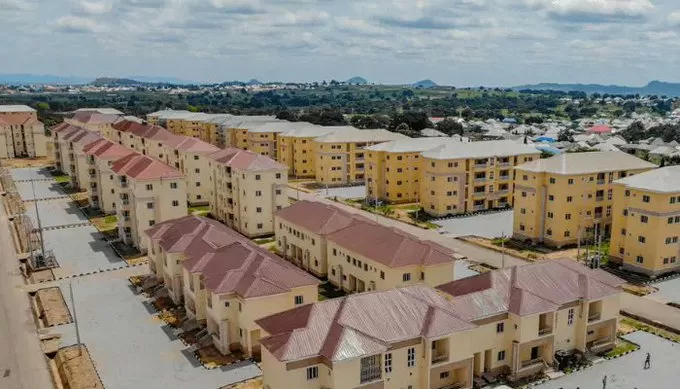
The Federal Government has approved uniform selling prices for housing units under the Renewed Hope Housing Estate project, a flagship initiative aimed at providing affordable homes for Nigerians across all states of the federation.
According to a statement released on Monday by the Federal Ministry of Housing and Urban Development, the approved prices are ₦8.5 million for a one-bedroom semi-detached bungalow, ₦11.5 million for a two-bedroom unit, and ₦12.5 million for a three-bedroom semi-detached bungalow.
The ministry said the uniform pricing structure is part of efforts to ensure fairness, transparency, and affordability in the sale of the housing units being constructed nationwide under President Bola Tinubu’s Renewed Hope Agenda.
Minister of Housing and Urban Development, Arc. Ahmed Musa Dangiwa, said the decision followed a comprehensive review of construction costs, infrastructure provisions, and financing arrangements with contractors and mortgage institutions. “We have harmonized prices across all sites to ensure equity and affordability for ordinary Nigerians. The Renewed Hope Housing Scheme is not for the wealthy but for hardworking citizens seeking decent shelter,” he said.
READ ALSO: Tinubu Congratulates Japan’s First Female PM Sanae Takaichi
Dangiwa added that beneficiaries will be selected through a transparent process coordinated by the Federal Mortgage Bank of Nigeria (FMBN) and other housing agencies, with preference given to civil servants, low-income earners, and members of cooperative societies.
He also emphasized that flexible payment plans and mortgage options would be made available through the National Housing Fund (NHF) to enable more Nigerians to own homes without financial strain. “No Nigerian should be denied the dignity of a decent home due to cost. This government is determined to make housing accessible to all,” he stated.
The Renewed Hope Housing Scheme, launched in early 2024, targets the construction of 100,000 housing units across the six geopolitical zones. The estates feature basic infrastructure such as paved roads, solar-powered streetlights, water supply, and green spaces.
Stakeholders in the housing sector have welcomed the move, describing it as a practical step toward addressing Nigeria’s housing deficit, currently estimated at over 20 million units.
The ministry further assured that ongoing projects in states including Kano, Lagos, Nasarawa, and Enugu would be completed and delivered to beneficiaries before the end of 2025.