


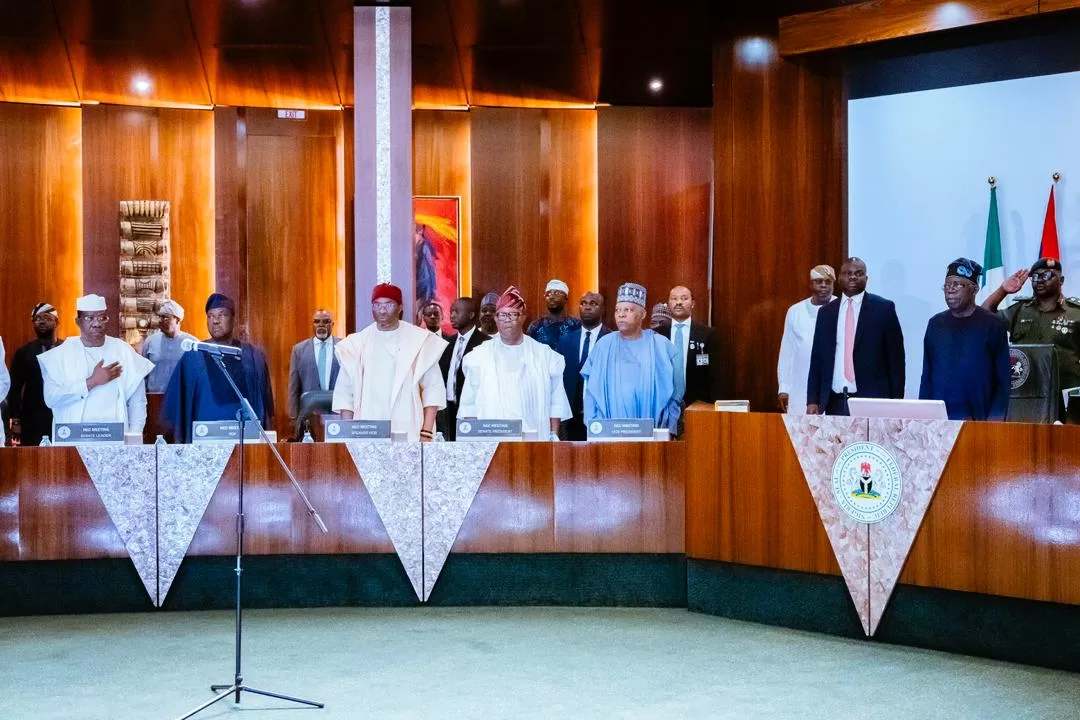
The National Economic Council (NEC) has approved President Bola Ahmed Tinubu’s proposal to overhaul and revamp training institutions for security agencies across Nigeria, as part of efforts to strengthen national security and enhance professionalism in the country’s law enforcement architecture.
The approval was granted during the Council’s 153rd meeting held Thursday at the Presidential Villa, Abuja, chaired by Vice President Kashim Shettima.
The decision followed a presentation by the Minister of Budget and Economic Planning, Senator Abubakar Atiku Bagudu, who highlighted the centrality of security sector capacity-building to the President’s vision of transforming Nigeria into a $1 trillion economy by 2033.
To fast-track implementation, NEC constituted a committee chaired by the Governor of Enugu State, Peter Mbah, to oversee the comprehensive overhaul of the training institutions of the Nigeria Police Force and sister security agencies nationwide.
Other members of the committee include Governors Uba Sani (Kaduna), Dapo Abiodun (Ogun), Kefas Agbu (Taraba), Umoh Eno (Akwa Ibom), Dauda Lawal (Zamfara), and Abdullahi Sule (Nasarawa), with former Inspector General of Police, Baba Usman, serving as Secretary. The committee was given one month to develop a detailed blueprint for the modernization of these institutions.
Addressing the Council, President Tinubu emphasized the urgent need to rehabilitate and retool training facilities for security agencies to improve learning conditions and operational readiness.
“We have to make the conditions of the training facilities more conducive for both the trainers and trainees,” Tinubu said, assuring that his administration would prioritize investments to reverse decades of neglect in the sector.
The President further urged governors to focus on the welfare of their citizens, particularly at the grassroots, noting that true governance must be measured by tangible improvements in people’s lives.
In his remarks, Vice President Kashim Shettima underscored that the Council’s deliberations were anchored on President Tinubu’s economic transformation blueprint. He stressed that the government’s success would be judged not by lofty rhetoric but by measurable progress in improving the lives of ordinary Nigerians.
“The measure of government is not in speeches delivered; it is in the lives improved,” Shettima said.
The Vice President also highlighted the administration’s new Anticipatory Action Framework for Riverine Flooding, developed by the Office of the National Security Adviser (ONSA), which shifts disaster management from reaction to prevention.
“It is no longer in doubt that rivers that once sustained our farmlands and livelihoods have also been the source of recurring tragedy for many of our citizens,” he noted, adding that proactive systems must be built to prevent avoidable losses.
He commended the National Security Adviser, Malam Nuhu Ribadu, for spearheading the initiative, which aims to strengthen early warning systems, inter-agency coordination, and state-level response capacities.
The NEC also received a major policy presentation from the Minister of Budget and Economic Planning, Sen. Bagudu, outlining Nigeria’s roadmap toward achieving a trillion-dollar economy within the next decade. Bagudu described the vision as a “test of coordination, clarity, and discipline” that demands joint effort from all tiers of government.
Vice President Shettima reaffirmed that the economic roadmap aligns with the Renewed Hope Agenda, focusing on macroeconomic stability, job creation, food security, and competitiveness among the states.
He also cited the Katsina Sustainable Platform for Agriculture (KASPA) as a model for integrating technology into agricultural governance. The digital platform, designed to enhance farmers’ access to markets, climate data, and financial inclusion, was recently launched by Governor Dikko Radda.
“KASPA is a scalable framework for digital governance, farmer inclusion, and climate-smart productivity ready for sub-national adoption,” Shettima said, encouraging other governors to replicate the initiative.
READ ALSO: Davido appointed chairman Osun Sports Trust Fund
During the session, the Council reviewed the country’s financial status, revealing balances as follows:
- Excess Crude Account: $535,823.39
- Stabilization Account: ₦87,665,172,169.67
- Natural Resources Account: ₦141,585,815,908.16
The Council also reviewed reports from various ad-hoc committees, including the Polio Eradication Committee chaired by Gombe State Governor, Muhammadu Inuwa Yahaya. The report indicated a 44% drop in circulating poliovirus cases, from 109 in 2024 to 61 in 2025, with Kano and Katsina recording 89% and 88% reductions respectively.
The Council urged states to maintain funding and commitment to ensure full eradication of the virus nationwide.
In another presentation, the Ad-Hoc Committee on Crude Oil Theft Prevention and Control, chaired by Imo State Governor Hope Uzodimma, updated the Council on ongoing engagements with industry stakeholders and security agencies. The committee announced plans to extend its oversight to cover illegal mining and other resource theft across the country.
The Council commended the committee’s work and projected that Nigeria’s crude oil output could rise to 2.5 million barrels per day by the end of 2025.
Concluding the meeting, Vice President Shettima lauded the collaborative spirit among governors, ministers, and federal officials, stressing that NEC remains a “platform of trust, cooperation, and policy innovation” critical to achieving the nation’s shared prosperity goals.
“The story of Nigeria’s recovery will not be written by chance but by choice—by the deliberate actions we take to protect our economy, safeguard our environment, and uphold the welfare of our citizens,” the Vice President said.

