
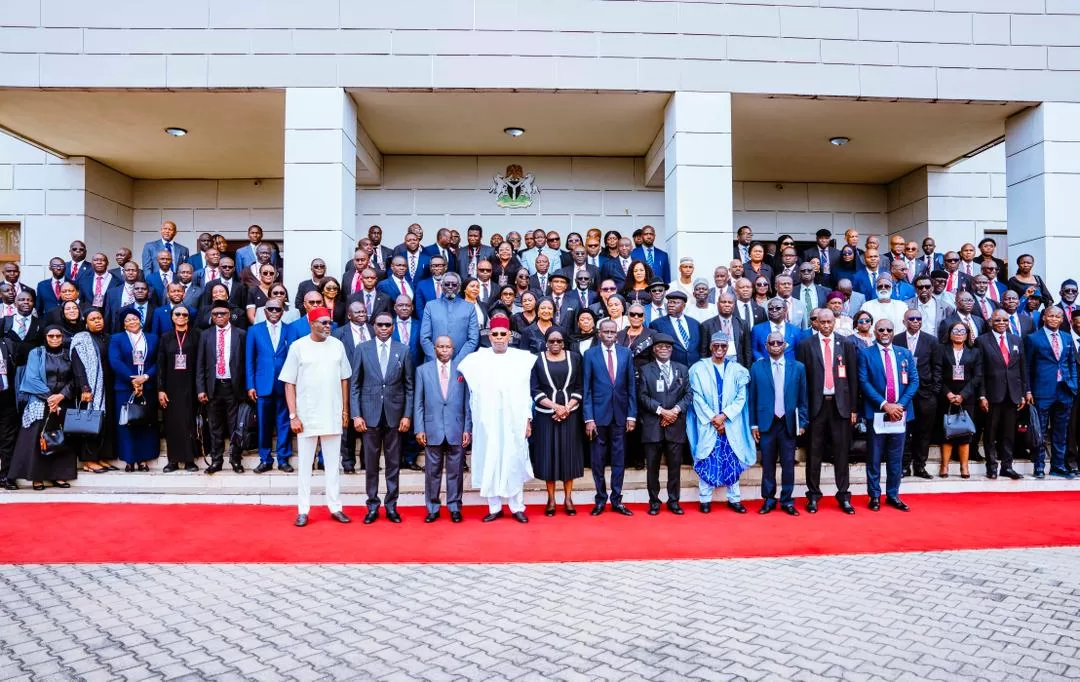
President Bola Ahmed Tinubu has called on the Nigerian judiciary to remain resolute, impartial, and incorruptible in the dispensation of justice, warning that the decay of any nation begins when its judicial system loses integrity.
The President made the call on Monday while declaring open the Economic and Financial Crimes Commission (EFCC) and National Judicial Institute (NJI) Workshop for Justices and Judges in Abuja. Represented by Vice President Kashim Shettima, he pledged his administration’s full support for the judiciary, emphasizing that recent remuneration reviews for judicial officers reflect the government’s commitment to strengthening judicial independence.
“We draw our moral distinction as a people from the judiciary, and we owe it the reverence and autonomy to remain the last sanctuary of our collective conscience,” Tinubu stated.
He expressed concern over the delays in adjudicating high-profile corruption cases while cybercrime-related cases are concluded swiftly, saying the situation undermines public confidence in the justice system.
“The theme of this year’s workshop Enhancing Justice in the Fight Against Economic and Financial Crimes is apt. It comes at a time when there is growing frustration over delays in corruption cases and the perception that justice is unevenly applied,” he said.
President Tinubu reiterated his administration’s hands-off policy in judicial and anti-graft matters, stressing that no individual or political group has been shielded from prosecution.
“There is no person or group who can accuse this administration of shielding political actors on account of their affiliation to this government or our party. We have allowed both the judiciary and the anti-graft agencies to exercise their constitutional and statutory powers,” he said.
Highlighting progress in the anti-corruption war, the President disclosed that the EFCC had recorded over 7,000 convictions and recovered assets worth more than ₦500 billion in the past two years.
He explained that the recovered funds are being channelled into social investment programmes, including the Students Loan Scheme and Consumer Credit Initiative, to support vulnerable Nigerians and stimulate economic growth.
President Tinubu also emphasized the need for judicial officers to embrace technological advancement in handling complex financial crime cases.
“Justice in the digital age demands new competencies. How does one do justice in a cryptocurrency fraud case except one is grounded in such matters? Learning and relearning are now essential,” he noted.
READ ALSO: Tiwa Savage Opens Up on Dating, Marriage Choices
He reminded judges that corruption affects all citizens equally, warning that no one is insulated from its consequences. “There are no special roads, hospitals, or communities for judges. A Nigeria free of corruption is possible if we all commit to doing what is right,” he added.
Chief Justice of Nigeria (CJN), Justice Kudirat Kekere-Ekun, urged judges to remain firm, fair, and deliberate in the discharge of their duties, stressing that the judiciary’s strength lies in the people’s trust.
Similarly, Senate President Godswill Akpabio, represented by Senate Chief Whip Mohammed Monguno, said fighting corruption requires the collaboration of the legislature, judiciary, and citizens.
EFCC Chairman Ola Olukoyede, SAN, commended the judiciary’s cooperation, noting that “the record of over 4,000 convictions and humongous recoveries could not have been achieved by a lazy or ineffective judiciary.”
The workshop, organized by the EFCC and NJI, serves as a platform to strengthen collaboration among the judiciary, law enforcement agencies, and policymakers in the ongoing fight against corruption.