


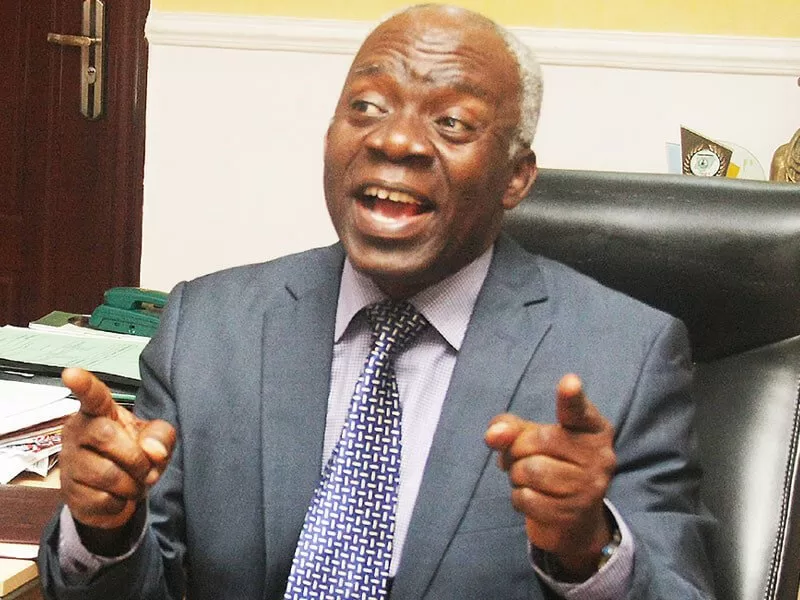
Human rights lawyer and Senior Advocate of Nigeria (SAN), Femi Falana, has said that the Nigerian judiciary has ceased to be the refuge of the common man, arguing that it now primarily serves the interests of the elite and the bourgeoisie.
Falana made the remarks on Wednesday while speaking to journalists after a courtesy visit to Abia State Governor, Dr. Alex Otti, in Umuahia. The renowned legal practitioner decried the sluggish pace of judicial processes in Nigeria, lamenting that while political cases receive swift attention due to strict legal timelines, civil and criminal matters involving ordinary citizens drag on for decades without resolution.
According to him, this imbalance reflects a deeper structural bias that prevents the masses from accessing justice. “People make the mistake of saying the judiciary is the last hope of the common man,” Falana stated. “The common man has no means to go to court. The judiciary is the last hope of the elite, the bourgeoisie. So if you want the ordinary people to benefit from the judicial system, you must promote authoritative disciplinary solutions.”
Falana emphasized that until fundamental reforms are undertaken to make the judicial system more accessible and efficient, justice will continue to elude millions of Nigerians. He urged the judiciary to adopt time-bound procedures for all cases, not just political ones, to ensure timely dispensation of justice. “Only the elite’s cases move in court because political cases are time-bound. Other cases, for me, must also be time-bound,” he added.
READ ALSO: Davido set to make Coachella debut
The senior lawyer’s comments come amid growing public concern about judicial delays, corruption, and the rising cost of litigation that keeps ordinary Nigerians from seeking redress through the courts. Legal analysts have often cited the backlog of cases, poor funding, and lack of accountability as major challenges facing the judiciary.
Falana’s call adds to ongoing demands from civil society groups for a comprehensive overhaul of Nigeria’s judicial system to make it more transparent, efficient, and people-oriented. Many have argued that the justice system must be decentralized and adequately funded to ensure quicker resolutions and fairer access for all citizens.
Meanwhile, Falana also recently took a swipe at Nigeria’s political establishment, blaming political parties for the nation’s persistent underdevelopment. Speaking during a Channels Television special broadcast marking Nigeria’s independence anniversary, he said political parties have failed to provide ideological direction and have instead entrenched a “winner-takes-all” culture that fuels corruption and impunity.
“The problem is that political parties lack ideology,” Falana said. “Without an ideological base or orientation, political parties will continue to promote corruption, impunity, and recklessness.”
He stressed that power must not be concentrated solely in the hands of the ruling party but should be shared across diverse constituencies to deepen democratic participation and accountability.
Falana’s remarks underscore his long-standing advocacy for judicial and political reform as essential pillars for national development and social justice in Nigeria.

