
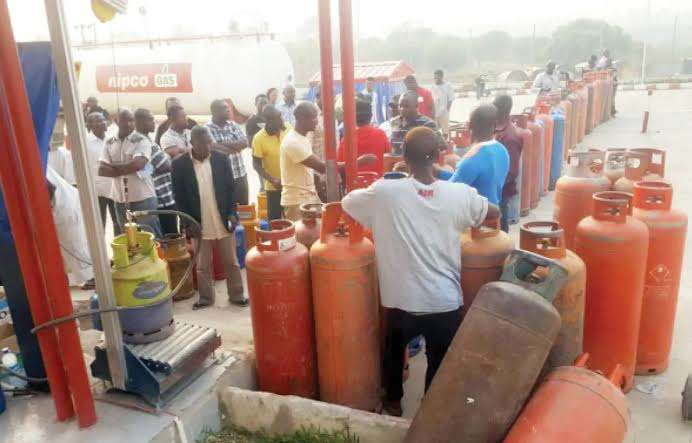
Despite official data suggesting a decline in the cost of Liquefied Petroleum Gas (LPG), residents across Lagos and Ogun states are reeling from a sharp increase in cooking gas prices, with some retail outlets now selling at record highs.
According to the latest report from the National Bureau of Statistics (NBS), the average cost of refilling a 5kg cylinder dropped from ₦8,243.79 in July to ₦6,404.02 in August 2025. However, findings from The Guardian reveal that consumers are paying far more in reality, with retail prices ranging between ₦1,800 and ₦3,500 per kilogram, depending on the area.
In Ijeshatedo, Lagos, residents described the situation as “frustrating and unbearable.” One consumer, identified as Mrs. Akinola, said she spent hours searching for gas before giving up. “Retailers are selling between ₦3,000 and ₦3,500 per kilogramme, while filling stations sell for around ₦2,500. The queues are endless, and many people leave without getting gas,” she lamented.
Similarly, in Atan, Ogun State, residents reported buying gas between ₦2,000 and ₦2,500 per kilogramme, while in Igando, Lagos, prices hovered between ₦1,800 and ₦2,000 depending on location and supplier. The sharp disparity between official statistics and market reality has left many households resorting to alternatives such as charcoal, firewood, and electric cookers.
Reacting to the price hike, the President of the Nigerian Association of Liquefied Petroleum Gas Marketers (NALPGAM), Olatunbosun Oladapo, attributed the surge to recent supply disruptions caused by the Petroleum and Natural Gas Senior Staff Association of Nigeria (PENGASSAN) strike and ongoing maintenance work at the Dangote Refinery.
“At the moment, most of our LPG supply is produced locally, and importation is minimal. However, the strike disrupted vessel berthing at Lagos terminals, creating a temporary shortage. The good news is that NLNG has supplied Port Harcourt in large volumes, which helped cushion the effect in the South-South,” Oladapo explained.
He assured that normalcy would return soon as loading and distribution resume fully. “Once logistics operations stabilise, prices should drop again,” he added.
READ ALSO: Atiku Faults INEC’s Commitment to Electoral Reforms
However, energy law expert and Partner at Bloomfield LP, Dr Ayodele Oni, criticised Nigeria’s persistent gas supply instability, saying it reflects structural inefficiencies within the sector.
“Even though domestic gas production has improved, a large share of the output is still exported. So, higher upstream production doesn’t necessarily mean more gas for local consumption,” Oni said.
He noted that domestic LPG sales rose by about 22 per cent year-on-year to 65,632 metric tonnes in March 2025, yet the impact on local bottling and retail supply remains limited.
As the price crisis deepens, experts warn that continued volatility in the LPG market could push more Nigerians toward unsustainable energy sources, undermining the government’s clean cooking initiative and worsening environmental challenges.
For now, many households in Lagos and Ogun are caught between affordability and access, waiting for relief that seems yet to arrive.