

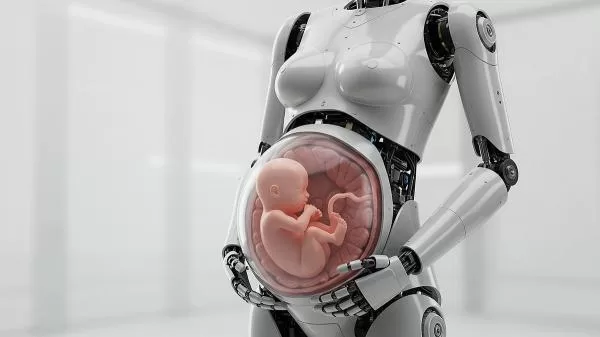
Chinese scientists have unveiled the world’s first humanoid “pregnancy robot” equipped with an artificial womb, in what could be a revolutionary step for reproductive science.
The robot, capable of carrying a human fetus to full term, was introduced by Dr. Zhang Qifeng, founder of Kaiwa Technology, during the 2025 World Robot Conference held in Beijing.
The innovation has already drawn global attention for its potential to revolutionize childbirth, particularly for infertile couples and aging populations facing declining birth rates.
According to Dr. Zhang, the artificial womb replicates essential functions of the human uterus, including an amniotic fluid environment, umbilical-like nutrient delivery, and precise temperature control. The robot can sustain a pregnancy for the entire gestation period—approximately 10 months.
“Our goal is to combine precision, safety, and compassion,” Dr. Zhang said. “We believe this technology will be a game-changer for reproductive science.”
The device is expected to be commercially available by 2026 at a cost of under 100,000 yuan (around $14,000 USD), significantly less than the average cost of surrogacy in most countries.
The artificial womb was originally tested in laboratory settings with animal embryos, but researchers now claim it is ready for human trials pending regulatory approval.
The announcement, however, has stirred debate around the world.
Medical experts, ethicists, and religious leaders are expressing both fascination and concern.
Critics argue that while the device may help solve infertility issues, it also risks commodifying childbirth and undermining the natural maternal bond. Others fear a slippery slope toward the dehumanization of reproduction.
“There’s still a great deal we don’t know about the long-term effects on babies born from such systems,” said Dr. Mei Lu, a bioethicist at Beijing Medical University. “The biological and psychological implications are not yet fully understood.”
China’s government has reportedly begun drafting regulatory frameworks to oversee the safe implementation of the technology, especially regarding fertilization protocols, embryo implantation, and childbirth mechanisms. Lawmakers in Guangdong Province have confirmed they are consulting with legal and scientific experts to address possible human rights and safety concerns.
READ ALSO: Google launches programme to train Nigerian developers in generative AI
Internationally, the development has reignited discussions on the future of ectogenesis—the growth of a fetus outside the human body. While artificial wombs have been tested in past years to support premature animal births, this marks the first instance where a full-term human pregnancy is being attempted using robotic technology.
Despite skepticism from some quarters, others see the robot as a breakthrough in medical science. Advocates argue that the technology could relieve health burdens on women, reduce complications from high-risk pregnancies, and offer hope to couples who cannot conceive naturally.
As the global medical community watches closely, one thing is certain: China’s pregnancy robot is pushing the boundaries of science, ethics, and the future of human reproduction.