
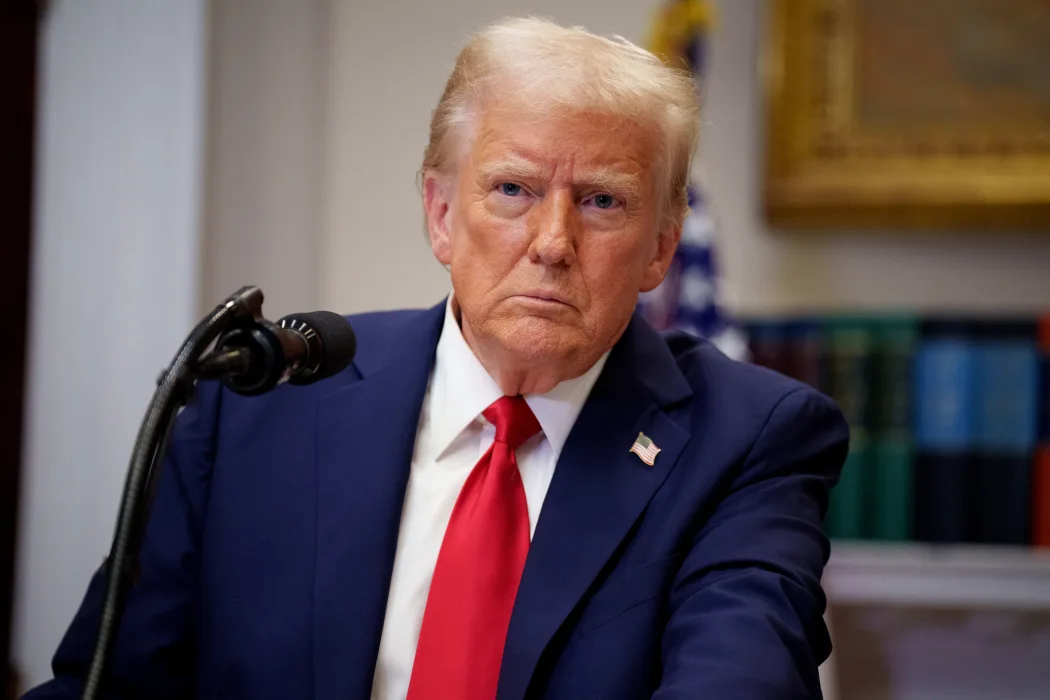
President Donald J. Trump on Wednesday called for the immediate resignation of Intel CEO Lip-Bu Tan, citing concerns over Tan’s past investments in Chinese technology firms allegedly linked to the Chinese military.
The President’s remarks have intensified scrutiny over foreign ties in the U.S. semiconductor sector and sent Intel’s stock tumbling.
“The CEO of INTEL is highly CONFLICTED and must resign, immediately,” President Trump wrote in a post on Truth Social. “There is no other solution to this problem. This man’s interests lie with CHINA, not the United States. He should not be anywhere near American chipmaking.”
Tan, who became Intel CEO in March 2025, has come under fire for his leadership at venture capital firm Walden International and his previous role as CEO of Cadence Design Systems.
Reports reveal that under his direction, Walden invested over $200 million into Chinese semiconductor and artificial intelligence startups, including firms with alleged links to the People’s Liberation Army.
Additionally, Cadence recently pleaded guilty to violating U.S. export controls by supplying sensitive chip-design software to a Chinese military-affiliated university.
The Trump administration is now reviewing Intel’s eligibility for continued funding under the CHIPS and Science Act, which has allocated billions of dollars to boost domestic semiconductor production.
“The American taxpayer should not be footing the bill for companies led by individuals with deep financial entanglements in Communist China,” the President said during a press briefing Thursday morning. “We are conducting a full review of Intel’s operations and leadership to ensure national security is never compromised.”
President Trump emphasized that restoring American control over the semiconductor industry is central to his administration’s economic and defense policy. “This is about putting America first,” he said. “We will not tolerate executives with divided loyalties overseeing critical technology infrastructure.”
Intel issued a written response defending its chief executive and rejecting claims of impropriety. “Intel and its CEO, Lip-Bu Tan, are deeply committed to U.S. national security,” the statement read. “Our company has complied fully with all federal guidelines under the CHIPS Act and maintains strict oversight of its global partnerships and investments. We are fully cooperating with congressional and federal oversight processes.”
Trump’s statement triggered immediate market reaction, with Intel’s shares falling over 3.5% in premarket trading on Wednesday. Some analysts fear the controversy could impact the company’s eligibility for future CHIPS Act funding and prompt wider scrutiny of executive leadership across the U.S. semiconductor industry.
Senator Tom Cotton (R-AR), a longtime critic of Chinese influence in U.S. tech, echoed the President’s concerns and urged the Intel board to act swiftly. “Mr. Tan’s financial record raises serious red flags,” Cotton said in a statement. “The board has a responsibility to the American people to ensure Intel is led by someone whose loyalties are unquestioned.”
READ ALSO: US to Start $15,000 Visa Bonds For Visitor, tourist visa applicants
Tan “reportedly controls dozens of Chinese companies and has a stake in hundreds of Chinese advanced-manufacturing and chip firms. At least eight of these companies reportedly have ties to the Chinese People’s Liberation Army,” Cotton wrote in his letter, a copy of which he posted on his website.
Cotton also noted Tan’s role as the previous head of Cadence Design Systems, which he said recently “pleaded guilty to illegally selling its products to a Chinese military university and transferring its technology to an associated Chinese semiconductor company without obtaining licenses.”
Tan was head of the company at that time, Cotton said.
The Malaysia-born tech industry veteran took the helm at struggling Intel in March, announcing layoffs as White House tariffs and export restrictions muddied the market.
He has said it “won’t be easy” to overcome challenges faced by the company.
Intel is one of Silicon Valley’s most iconic companies, but its fortunes have been dwarfed by Asian powerhouses TSMC and Samsung, which dominate the made-to-order semiconductor business.
The company was also caught by surprise with the emergence of Nvidia as the world’s preeminent AI chip provider.
Intel’s niche has been in chips used in traditional computing processes, steadily being eclipsed by the AI revolution.