
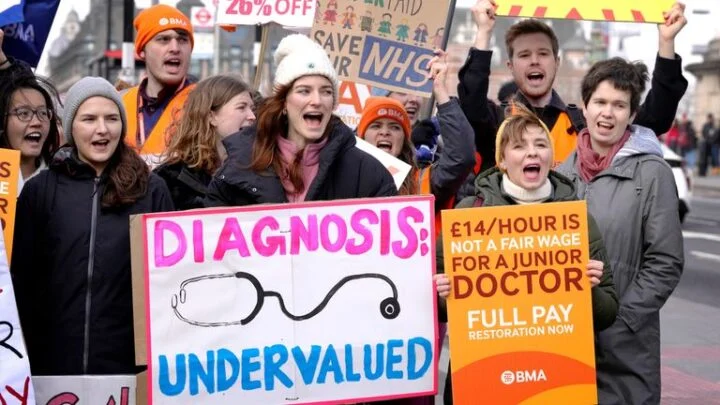
Thousands of resident doctors across England began a five-day strike on Friday, July 25, 2025, after negotiations with the government failed to yield a resolution.
The industrial action, which started just hours after late-night talks collapsed on Thursday, is the latest chapter in a long-running pay dispute between the British Medical Association (BMA) and the government.
Doctors were out on picket lines outside hospitals after negotiations with the government went down the wire late Thursday, without reaching an accord.
The strike comes despite a pay rise agreement totalling 22.3 percent over two years, which the doctors accepted in September 2024 following the Labour Party’s rise to power. However, resident doctors — those below consultant level — have said they felt they had “no choice” but to strike again to reverse “pay erosion” since 2008.
The co-chairs of the BMA’s Resident Doctors Committee, Melissa Ryan and Ross Nieuwoudt, defended the strike action, saying:
“We’re not working 21 percent less hard so why should our pay suffer?”
They added, “Pay erosion has now got to the point where a doctor’s assistant can be paid up to 30% more than a resident doctor. That’s going to strike most of the public that use the NHS as deeply unfair.” The doctors argue that they are asking for “an extra £4 per hour to restore our pay. It’s a small price to pay for those who may hold your life in their hands.”
Prime Minister Keir Starmer on Friday urged doctors to reconsider, warning in a letter published by The Times that the strikes would “cause real damage” to the National Health Service (NHS). “Launching a strike will mean everyone loses,” Starmer wrote, calling on doctors not to “follow” the BMA “down this damaging road.
READ ALSO: Nationwide Strike: Doctors give FG until Saturday to meet demands
Our NHS and your patients need you.” He added, “Lives will be blighted by this decision,” highlighting the potential harm to patients and further strain on an already stretched NHS.
Health Minister Wes Streeting also appealed to the doctors to call off the strike. In a letter published in The Telegraph, he said the government “cannot afford to go further on pay this year.” He criticized the BMA leadership for choosing confrontation over dialogue, stating, “Despite a 28.9% pay rise for their members over the last three years… the BMA leadership chose to walk away from talks and lay the damage at the NHS’s door.”
Last year’s strikes by junior doctors caused the cancellation of tens of thousands of appointments and procedures, and were part of a broader wave of industrial action across public and private sectors in the UK in response to soaring inflation.
Labour had sought to end this wave of unrest after taking office by offering deals to public sector workers, including a 15 percent pay agreement for train drivers, a deal that was heavily criticized by the Conservative opposition.
Despite assurances that emergency and urgent care services will remain in operation, the NHS has warned of significant disruptions during the strike. Patients have been urged to attend appointments unless informed otherwise, but the health service is preparing for delays and rescheduling across multiple departments.
As the dispute intensifies, both sides remain far apart. The government insists it has gone as far as it can on pay this year, while doctors say their strike is a last resort to address a long-standing pay injustice. The situation remains fluid, with public frustration growing and fears mounting over the long-term impact on NHS performance and patient care.