

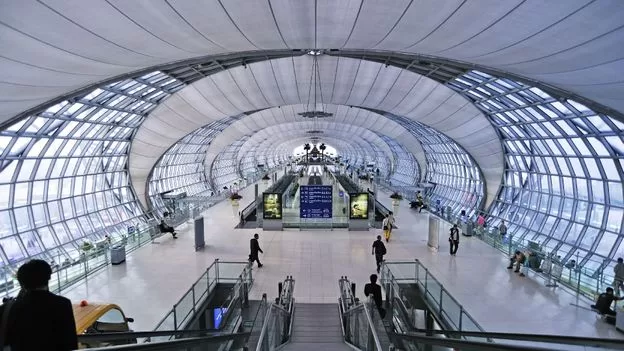
Airports aren’t usually places we associate with beauty or inspiration. Most of the time, we’re just trying to survive long security lines, overpriced coffee, and jet lag. But once in a while, you stumble into an airport that makes you stop and say, “Wait… this is an airport?”
From floating gardens to architecture worthy of museums, here are ten airports around the world that blew me away, not just for being easy to travel through, but for being genuinely, stunningly beautiful.
1. Changi Airport (SIN) – Singapore 🇸🇬
Changi Airport consistently ranks among the world’s finest, and for good reason. Its most distinctive feature is the Jewel Changi complex—a domed glass structure housing a lush indoor rainforest and the Rain Vortex, the world’s tallest indoor waterfall. Surrounded by gardens, sky bridges, and interactive exhibits, the Jewel offers a tranquil escape from the fast pace of travel. Inside the terminals, passengers will find themed zones, art installations, butterfly gardens, and an extensive range of dining and retail options. Every aspect of Changi is designed to be immersive, visually calming, and technologically advanced, setting a global benchmark for airport design.
2. Hamad International Airport (DOH) – Doha, Qatar 🇶🇦
Characterized by sweeping lines and expansive open spaces, Hamad International Airport is a model of contemporary Middle Eastern design. Its fluid architecture is meant to evoke the gentle curves of sand dunes, while its use of glass and natural light adds a sense of openness and serenity. Notable interior features include vast art installations, such as Urs Fischer’s 23-foot yellow Lamp Bear, as well as serene lounges, high-end shopping, and wellness facilities. The airport’s recent expansion introduced an indoor tropical garden and advanced passenger experience technologies, reinforcing its status as one of the world’s most visually and functionally impressive terminals.
3. Incheon International Airport (ICN) – Seoul, South Korea 🇰🇷
Incheon Airport seamlessly blends efficiency with aesthetic appeal. Its spacious layout, use of glass and light, and calming color palette create a refined, stress-free environment. What distinguishes Incheon architecturally is its incorporation of Korean cultural elements. Traditional gardens, exhibition spaces, and performance areas dedicated to Korean music and dance reflect the country’s heritage. The terminal interiors are thoughtfully designed to provide comfort, while the infrastructure itself ensures smooth passenger flow. Incheon has become a standout example of how cultural identity can be embedded into a globally functional space.
4. Munich Airport (MUC) – Germany 🇩🇪
Munich Airport stands out for its clarity of design and welcoming atmosphere. The central terminal area, enclosed by a massive glass canopy, serves as a multifunctional event space and communal hub. Seasonal installations, such as a winter market complete with an ice rink, give the airport a distinctive character throughout the year. Interiors are defined by natural materials, wide concourses, and clean lines. Munich’s fusion of modern architecture with Bavarian cultural touches contributes to an airport environment that is both efficient and regionally expressive.
5. Kansai International Airport (KIX) – Osaka, Japan 🇯🇵
Designed by Renzo Piano, Kansai International Airport is a feat of engineering and design, built on an artificial island in Osaka Bay. The terminal features an elongated, aerodynamic structure with a curved roof that mirrors the movement of waves. Its design prioritizes simplicity and flow, offering unobstructed views of the sea through floor-to-ceiling glass. Inside, the minimalist aesthetic common in Japanese design is evident—spaces are functional yet graceful, with an emphasis on natural lighting and symmetry. The airport’s structural innovations and serene interiors make it one of Asia’s most architecturally acclaimed air travel hubs.
READ ALSO: Top 10 Mistakes Students Make While Studying Abroad in Europe
6. Vancouver International Airport (YVR) – Canada 🇨🇦
Vancouver International Airport is celebrated for its integration of art, culture, and the natural world. The terminal features extensive installations of Indigenous Pacific Northwest art, presented alongside waterfalls, aquariums, and wood and stone textures that reflect the surrounding landscape of British Columbia. Large windows frame views of the mountains and ocean, while indoor features such as the Pacific Passage gallery offer immersive cultural storytelling. The design prioritizes a strong connection between the built environment and the region it represents, making YVR one of the most distinctively Canadian airports.
7. Adolfo Suárez Madrid–Barajas Airport (MAD) – Spain 🇪🇸
Terminal 4 of Madrid–Barajas Airport, designed by Richard Rogers and Antonio Lamela, is one of Europe’s most aesthetically striking terminals. Its design emphasizes light, rhythm, and natural materials. A roof of undulating bamboo panels stretches across the structure, supported by vibrant, color-coded columns that also aid in navigation. Skylights and clerestory windows allow natural daylight to illuminate the terminal, creating a warm and spacious atmosphere. This terminal blends function with expressive architectural form, resulting in a travel experience that is both practical and visually engaging.
8. Beijing Daxing International Airport (PKX) – China 🇨🇳
Beijing Daxing Airport is an architectural statement, conceived by Zaha Hadid Architects to embody both futuristic design and operational efficiency. Its radial, starfish-like layout minimizes walking distances while offering continuous sightlines across the terminal. At the heart of the structure, a vast central atrium is illuminated by a series of skylights that cast patterned light across the terminal floor. The design embraces biomorphic principles, with curved, flowing forms and a golden-hued color palette that softens the immense scale of the structure. Daxing represents a new frontier in airport design—monumental, efficient, and unmistakably modern.
9. Wellington International Airport (WLG) – New Zealand 🇳🇿
Wellington Airport’s uniqueness lies in its bold and unconventional architecture. The terminal expansion known as “The Rock” was designed to resemble the jagged geology of New Zealand’s southern coast. Its copper-hued panels and angular forms stand in sharp contrast to conventional airport design. Inside, the space maintains a cave-like ambiance with dim lighting and textured walls, providing a deeply atmospheric experience. Supplementing the visual design are large-scale film-related installations, reflecting Wellington’s close connection to the country’s film industry. The airport’s striking architecture and local identity make it a standout on a global stage.
10. Marrakech Menara Airport (RAK) – Morocco 🇲🇦
Marrakech Menara Airport is an elegant blend of modernist design and Moroccan tradition. The terminal’s most notable feature is its ornate latticework façade, constructed from a geometric pattern of glass and concrete that filters natural light into the interior in dramatic fashion. Inside, the architecture draws heavily from Islamic motifs—ornamental tiling, arched structures, and carved woodwork are used to elevate the space beyond standard functionality. The airport’s design serves as a cultural prelude to Marrakech itself, capturing both the region’s aesthetic heritage and its aspirations for modern sophistication.
Conclusion
Each of these airports offers more than just transit—they provide a distinct sense of place and a memorable experience for travelers. Whether through innovative architecture, cultural storytelling, or environmental harmony, these ten airports redefine the expectations of modern travel, proving that the journey can be just as visually rewarding as the destination.