
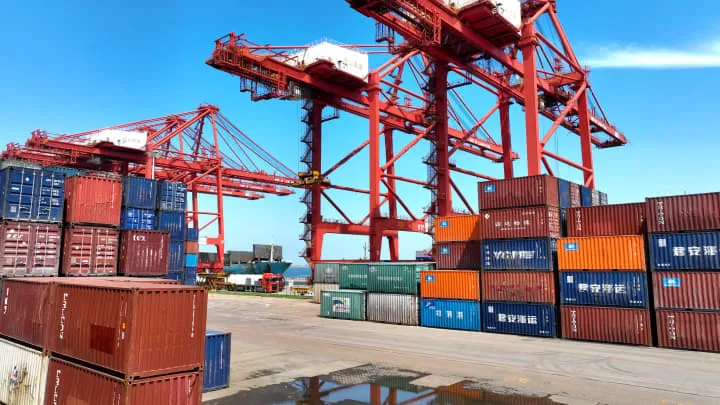
China has announced it will impose additional tariffs of 34 per cent on imports from the US in retaliation for duties of the same amount unveiled by President Donald Trump this week as part of his aggressive trade agenda.
Trump on Wednesday announced that China would be hit with a 34-percent tariff, on top of the 20 percent he imposed earlier this year, bringing the total new levies to 54 percent.
The Ministry of Commerce said on Friday that the tariff would be imposed on all imported goods originating from the US from April 10.
“For all imported goods originating from the US, an additional tariff of 34% on top of the current applicable tariff rate will be imposed,” Beijing’s finance ministry said.
China’s commerce ministry said that it would also impose more restrictions on the export of rare earths, which are used in hi-tech manufacturing such as batteries and electric vehicles. It added a further 16 US companies and organisations to its export control list, meaning that Chinese companies are restricted from doing business with them.
China had previously promised “resolute countermeasures” against Trump’s tariffs, which slapped a 10% rate on all imports coming to the US, with extra levies for certain countries, including China.
China’s state council tariff commission said: “On April 2, 2025, the US government announced the imposition of ‘reciprocal tariffs’ on Chinese goods exported to the US. This practice of the US is not in line with international trade rules, seriously undermines China’s legitimate rights and interests, and is a typical unilateral bullying practice.”
Trump responded on Truth Social on Friday. He said: “CHINA PLAYED IT WRONG, THEY PANICKED – THE ONE THING THEY CANNOT AFFORD TO DO!”
Financial Times on Friday reports that levies on Chinese exports are set to rise to more than 60 per cent after the US president announced “reciprocal” tariffs of 34 per cent that come on top of existing tariffs.
Beijing denounced the new US duties as “a typical unilateral bullying move” that “does not comply with the rules of international trade and seriously damages the legitimate rights and interest of China”.
Beijing also announced controls on exports of medium and heavy rare earths, which are materials used in high-tech products such as computer chips and electric vehicle batteries, from April 4.
“The purpose of the Chinese government’s implementation of export controls on relevant items in accordance with the law is to better safeguard national security and interests, and to fulfill international obligations such as non-proliferation,” China’s commerce ministry said in a statement.
READ ALSO: Trump presents ‘Gold Card’ for rich immigrants to U.S.
The Chinese government also said it would add 16 US entities to its export control list, which bans the export of dual-use items to affected firms.
Another 11 US firms were included on the “unreliable entities” list, which allows Beijing to take punitive action against foreign entities. The targeted firms includes Skydio Inc and BRINC Drones over arms sales to democratically governed Taiwan, which China claims as part of its territory.
The Commerce Ministry announced anti-dumping investigations into imported medical CT X-ray tubes originating from the US and India.
Beijing has also announced that it will file a lawsuit with the World Trade Organization over the latest tariffs.
As part of its complaint, Beijing argued the measures violate WTO rules and requesting consultations.
“China has filed the WTO complaint with respect to the United States’ measures,” the Permanent Mission of China to the World Trade Organization said in a statement.
Escalation of a trade war featuring the world’s two largest economies sent US stock futures sharply lower on Friday, signalling more losses on Wall Street, after the Trump administration’s sweeping levies knocked off $2.4tn (£1.8tn) from US equities.
The FTSE 100 in London shed more than 300 points since the start of trading on Friday, its biggest one-day decline since March 2023. The Stoxx 600 index of Europe’s largest six hundred companies slumped by 4.4%.
The price of Brent crude oil has dropped 6.6% to $65.50, its lowest since August 2021.
Wang Wen, the dean of Renmin University of China’s Chongyang Institute for Financial Studies, said: “China will never give in to Trump, but it does not exclude cooperation with the United States at the level of mutual respect and win-win cooperation. China knows that cooperation is not sought, but fought for.” Wang said that China’s response was “restrained” and limited to trade measures.
“By matching Trump’s tariffs, China is no longer nibbling at the edges — it’s mirroring US actions head-on. This is not blind retaliation, but a clear recalibration,” said Craig Singleton, a senior fellow at the US-based Foundation for Defense of Democracies